
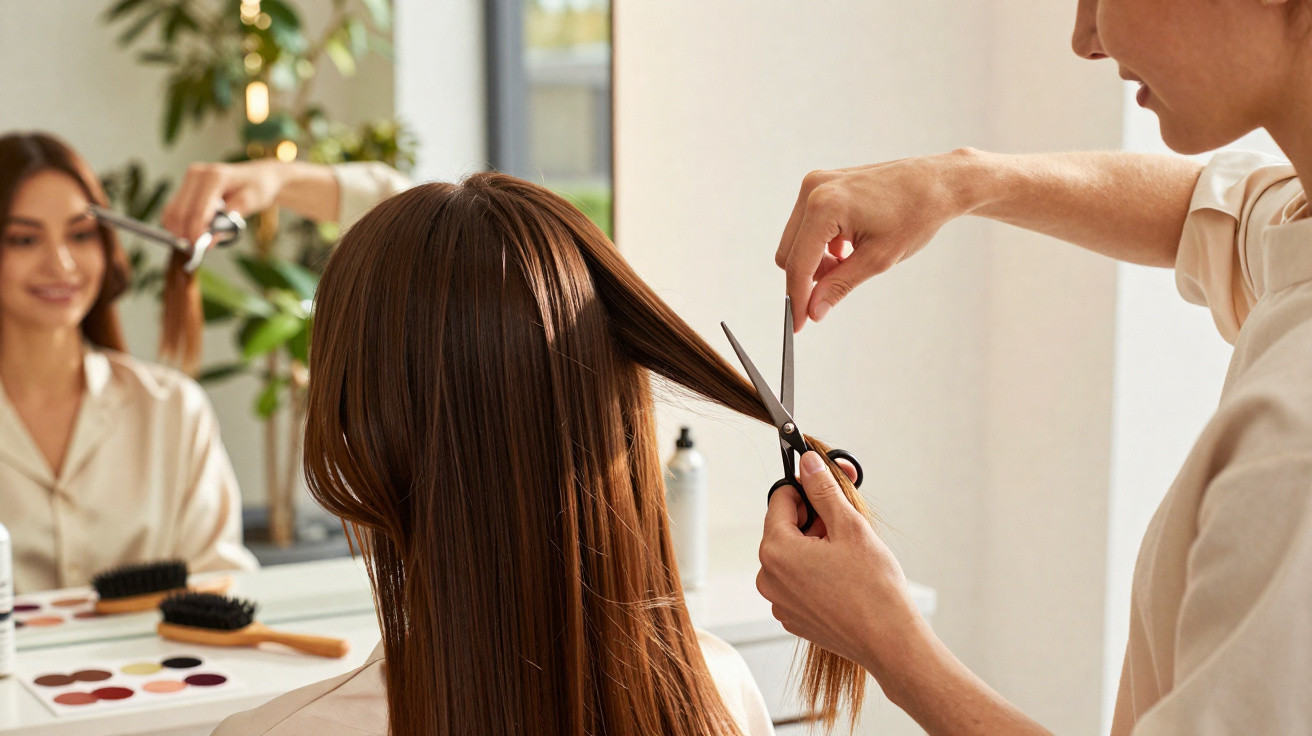
Many people know the feeling: your hairstyle looks great in the morning, but by lunchtime it is limp and flat against your head. Fine hair in particular quickly loses its shape in spring because of humidity, changing temperatures and heavy care products. Rather than applying even more styling products, professional hairdressers are currently relying on an internal cutting technique that creates lift at the roots and specifically supports the hair structure.
Why fine hair falls flat so quickly in spring
Fine hair naturally has a smaller diameter and is often less dense too. As a result, every added burden – whether from care products, styling or humidity – makes it go flat more quickly. Spring brings together a combination of factors that worsens the issue: more perspiration on the scalp, frequent rain, wind and the desire for airy hairstyles worn loose.
Many people instinctively respond with volumising mousse, dry shampoo, hairspray and rich masks. Yet the outcome is often the opposite of what they want: the hair looks weighed down, the lengths pull the roots downwards, and the structure collapses before late morning.
“Anyone with fine hair needs the right haircut first and foremost – not the next styling product.”
Dermatological professional bodies also point out that hair fibres become finer with age. Hormonal changes can cause the perceived density of hair to decrease by up to one third. The implication is clear: volume is better addressed through a mechanical, in other words skilled cutting, solution than through ever more pots and bottles in the bathroom.
Haircuts that genuinely benefit fine hair
For fine hair, professionals favour defined shapes that provide lift instead of cutting the hair into countless thin wisps. Certain lengths and outlines have proved particularly effective at making the head appear visually fuller.
These cuts create instant fullness
- Classic short bob: A compact, precisely cut bob ending just above or at chin level places weight where it is needed. The silhouette looks fuller, while the nape appears to have more volume.
- Mid-length cut with subtle layers: A shoulder- or collarbone-length cut with gently integrated layers adds movement without thinning out the ends. The tips retain their strength and the shape gains bounce.
- Pixie or bixie cut: Those willing to go short can achieve surprisingly substantial volume with a textured cut. Varying lengths across the crown create the visual impression of far more hair, even with a very fine texture.
The key is always for the cut to concentrate the “mass” where volume should be visible – on the crown and around the back of the head. Long, completely unstructured hair pulls everything down and can make fine hair look even thinner.
Common cutting mistakes with fine hair
Things often go wrong when hairdressers or clients try to achieve too much and cut too deeply into the hair:
- Excessively long hair with no shape at all can make the ends appear see-through.
- Heavily thinned layered cuts create wisps rather than fullness.
- Radical thinning techniques may remove weight, but they also take away precisely the substance that fine hair urgently needs.
The better approach is to build support from within – which is where a little-known professional technique comes in, one that is especially popular in many salons during spring.
The secret volume technique: “Piquage” at the roots
Within the profession, this is known as internal layering: rather than visibly dividing the hair into different lengths, small supporting structures are created inside it. The term “Piquage at the roots” sounds technical, but it describes a remarkably simple effect.
The hairdresser works very close to the scalp, within the body of the hair. Tiny sections are selected and shortened very slightly. Instead of lying neatly flat, these shorter sections act as micro-supports that gently raise the longer hair above them.
“Small, hidden supporting strands push the hair above them upwards – the roots look denser without the ends suffering.”
This intervention is barely visible from the outside. The outline remains soft and the external length, especially at the ends, is left untouched. The result is most noticeable when blow-drying: the hair suddenly lifts more easily at the roots, and the style lasts longer, even when it is humid outside or the scalp is perspiring.
Which hair lengths suit the Piquage technique?
Internal layering works with different base cuts, provided there is still some length to work with:
- Compact short bob: An ideal choice, as the hidden layers lift the back of the head and create a rounded, full shape.
- Mid-length layered cut: The crown can be supported with precision without making the lengths look thin.
- Textured short haircut: With pixie and bixie variations, volume across the crown can be controlled accurately.
This cutting service is particularly useful shortly before summer, as heat and perspiration otherwise make roots collapse even faster. The internal supporting strands help the shape remain stable for longer.
Colour as a volume enhancer: depth instead of a uniform look
Colouring can also do a great deal to create the appearance of fullness. What matters is how light falls through the hair and how depth is produced.
A multidimensional balayage look, using very fine sections in similar tonal levels, creates shadows and points of light. This makes hair appear denser without producing a harsh, blocky striped effect. Shiny, slightly translucent tints further enhance the impression of lively movement.
By contrast, monochrome colours that are extremely dark or extremely light, with no tonal variation at all, can look like a flat surface. Particularly on fine hair, this may intensify the impression that there is very little structure. Subtly placed light-dark contrasts around the crown and face give the hairstyle a three-dimensional character – a trick many hairdressers deliberately use for “fake volume”.
At-home care and styling: what creates volume – and what ruins it
Even the best cut offers little benefit if a bathroom routine undoes its effect. Fine hair responds sensitively to residue, silicones and over-conditioning. A streamlined, uncomplicated routine helps preserve the volumising result from the salon for as long as possible.
The most important rules for care and styling
- Clarify the scalp regularly: Use a mild clarifying shampoo once a week to remove styling residue and oil. This allows the hair to stand more freely at the roots again.
- Choose lightweight products: Fluids, sprays and light mousse textures are preferable to heavy creams or rich oils that weigh hair down.
- Try “reverse washing”: Apply a light conditioner to the lengths first, leave it briefly, then shampoo mainly at the roots. Nourishing ingredients remain at the ends while the roots stay airy.
- Blow-dry correctly: First dry the hair upside down until around 80 per cent of the moisture has gone. Then stand upright, arrange it with your fingers and finish drying on a low heat.
- Keep heat use to a minimum: Use straighteners and curling tongs sparingly, as excessive heat weakens the hair fibre over time and can make it appear even finer.
One illustrative example from salons is that many clients who used rich masks and silicone-heavy products for years report noticeably longer-lasting volume after switching to lighter care and choosing a cut built up internally – entirely without finishing every day with hairspray.
What to ask for at the salon
Anyone planning their next hair appointment should clearly explain their goal. Broad comments such as “a bit more volume” are often not enough. Specific requests and terms that professionals can work with are more useful.
Helpful ways to phrase it include:
- “I have very fine hair and would like more lift at the roots, without the ends looking thin.”
- “Can we create internal layers that are barely visible but add volume?”
- “I would like to keep the length largely as it is; I am happy for some work to be done inside the hair only.”
It is also helpful to show a photograph of your hair at different points in the day – in the morning and at lunchtime. This lets the hairdresser see exactly where volume disappears and plan the cutting technique accordingly.
Keeping fine hair strong in the long term
Volume starts with the hair itself. A balanced diet containing sufficient protein, trace elements and vitamins supports hair growth, even though it cannot completely change genetically determined hair texture. Stress, lack of sleep and nicotine are regarded as factors that place additional strain on hair.
Anyone noticing changes in density or hair thickness should seek medical advice if in doubt, rather than relying on styling products alone. Many forms of perceived hair loss can at least be assessed – and taken into account when adapting the cut and routine.
With a carefully planned haircut, targeted internal layering and a light, straightforward care routine, fine hair can show considerably more volume in spring than many expect. The crucial factor is less often found on the chemist’s shelf than in the scissors of a professional working out of sight, very close to the scalp.






Comments
No comments yet. Be the first to comment!
Leave a Comment