
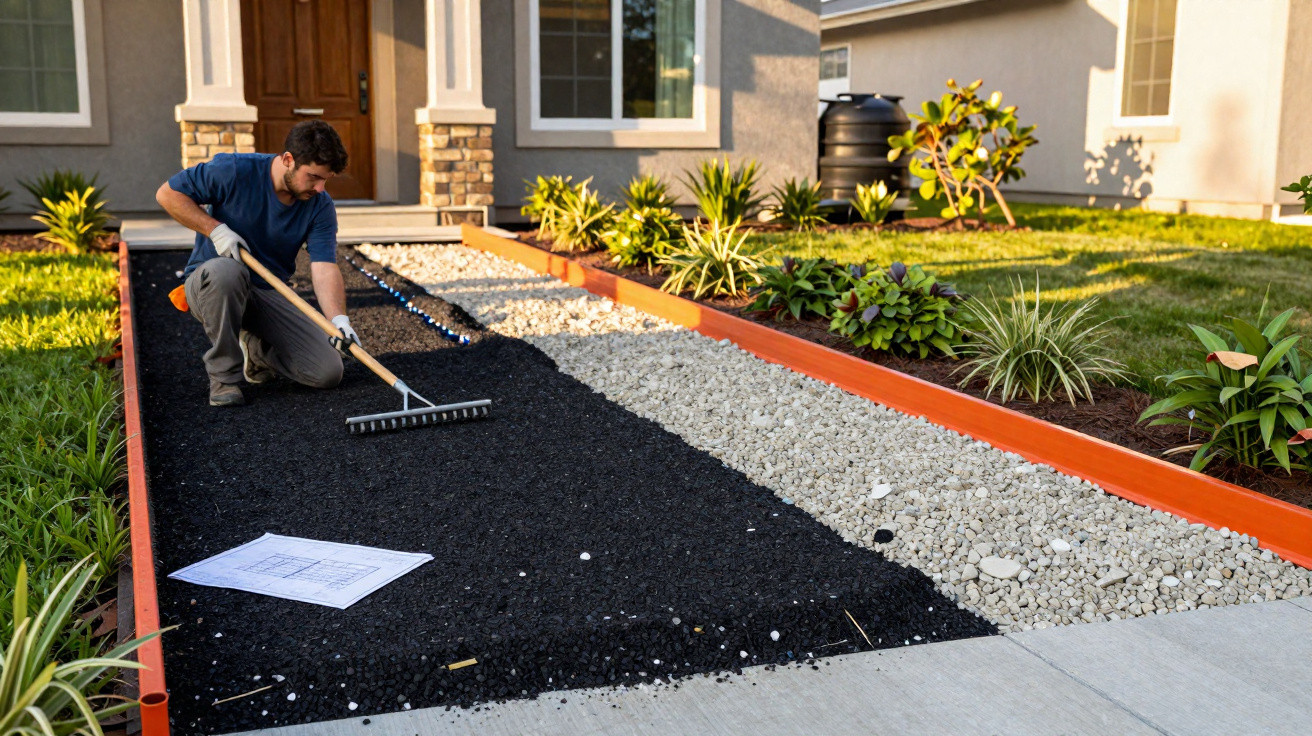
Cracked surfaces, puddles that linger for days and grey heat islands in summer: this is the reality for countless driveways. As concrete prices rise and local authorities increasingly restrict sealed surfaces, one question is becoming more pressing: how can you build a practical driveway that protects both your budget and the environment without sacrificing stability?
Why a continuous concrete slab has become a problem
Concrete is still viewed by many homeowners as a safe bet. Pour it once and leave it alone for decades – that is the expectation. Increasingly, however, that calculation no longer works. For one thing, the complex production of cement, the binding agent in concrete, significantly increases CO₂ emissions. Specialist sources estimate that cement manufacturing accounts for almost one tenth of global emissions.
A continuous, fully impermeable slab is also increasingly out of step with the policy direction of many towns and local authorities. Rules designed to limit soil sealing and improve rainwater infiltration are pushing authorities to make driveways and parking spaces less heavily surfaced. Every square metre that can no longer absorb water puts extra pressure on sewers and wastewater treatment works, while worsening flood risks during heavy rainfall.
There is also the cost. In Germany, a carefully installed concrete driveway commonly costs between €85 and €160 per square metre, including the sub-base. If deep cracking develops later, matters can become expensive: patch repairs are immediately noticeable, while extensive remedial work can quickly run into four- or even five-figure sums again.
Concrete slabs may seem “definitive” – but in reality, they make you inflexible, expensive and unforgiving towards rainwater.
Recycled asphalt: a hard-wearing car driveway at a lower cost
One alternative already well established in road construction and now increasingly used on private land is recycled asphalt. Professionals refer to it as processed planings: old roads are removed, crushed, rebound and laid again. Waste is turned into a new driving surface.
How recycled asphalt is made and what it delivers
When a road is dismantled, its upper layer is removed and broken into pieces. The fragments pass through a processing plant, where they are sorted, blended and combined with fresh binder. The resulting material is then laid as a surface on paths, yards or driveways.
This circular process conserves raw materials such as gravel and bitumen, cuts transport distances and reduces energy demand compared with constructing an entirely new surface. In practice, asphalt driveways – whether they contain recycled material or not – generally last between 15 and 30 years. The material responds more flexibly to heat and frost than rigid concrete slabs, making deep, continuous cracks less likely.
The cost of recycled asphalt
The surface becomes particularly appealing when you look at the budget. While a high-quality concrete driveway can soon reach three-figure prices per square metre, asphalt driveways containing recycled material are usually substantially cheaper. For a professionally constructed surface, approximately €26 to €72 per square metre is realistic, including the sub-base. Standard asphalt often sits in the middle of this range.
For those also focused on environmental impact, there are options that absorb rainwater more effectively or use alternative binders:
- Porous asphalt: its open structure allows water to infiltrate more quickly; it typically costs around €50 per square metre.
- Plant-based binder asphalt: replaces part of the petroleum-based content; it costs roughly 20 per cent more than the standard option but improves the CO₂ balance.
For households with a heavily used driveway and regular car traffic, recycled asphalt is therefore a compromise: strong, considerably less expensive than concrete and made partly from reused material.
Crushed concrete: affordable, permeable and surprisingly practical
Homeowners can reduce costs even further with crushed concrete. Old slabs and structural components are broken up, cleaned and crushed into different grades. The finished material often contains sand, aggregates and remnants of mortar – a mix that compacts into a surprisingly stable load-bearing layer.
Permeable ground instead of a rigid slab
Used for a driveway, crushed concrete creates a semi-bound surface. It is far firmer than loose gravel but remains open enough for rainwater to drain into the ground. Fewer puddles form, the sewer system is relieved and the soil beneath the surface does not dry out completely.
For many people, the price is a revelation: in many regions, recycled concrete costs up to 50 per cent less than comparable loose materials such as decorative gravel or natural stone. On long driveways extending for several dozen metres, the difference can soon add up to several thousand euros.
Everyday advantages and drawbacks
Maintenance requirements are modest. Leaves and twigs can be swept or blown away, while occasional depressions can be topped up and compacted using a vibrating plate or hand tamper. This keeps the surface load-bearing and reasonably level.
At the same time, the surface shares certain characteristics with gravel:
- Tyre tracks may become deeper over time.
- Driving quickly can kick up dust, soiling wheels, sills and the entrance area.
- Fine chippings may be carried into the home.
Crushed concrete is not for perfectionists – but it is a bargain for long, permeable driveways.
People who want to control driveway weeds without chemicals often turn to household remedies. One widespread mixture combines water, vinegar, coarse salt and a little washing-up liquid. Specialist sources, however, warn against using it generously: salt acts like a steriliser in the soil, damages soil life and should only be used on surfaces that are already impermeable or have their own drainage system.
Which surface suits which house?
The decision between recycled asphalt, crushed concrete and the remaining option of conventional concrete depends largely on use, ground conditions and budget. This broad comparison provides some guidance:
| Option | Typical use | Water infiltration | Cost level |
|---|---|---|---|
| Concrete slab | Smart driveway, crisp edges | Virtually impermeable | High |
| Recycled asphalt | Frequently used driveway, parking spaces | Moderate, better with drainage variants | Medium |
| Crushed concrete | Long driveways, rural properties | Highly permeable | Low |
Visual considerations also matter: asphalt has a dark, technical appearance, whereas crushed concrete looks coarser and more rustic. Those who like greenery can combine the surface with grass-reinforcement grids or planted edge strips, deliberately accepting a slightly “imperfect” look.
Tips for planning, sub-bases and drainage
Whichever surface is ultimately used for the driveway, the foundation determines both its lifespan and day-to-day practicality. A durable construction normally follows similar steps:
- excavate to sufficient depth, taking frost depth into account;
- install a load-bearing, well-compacted crushed-stone sub-base;
- allow for a gradient of around two per cent away from the house;
- direct water purposefully into beds, swales or an infiltration trench.
Where the ground contains a high proportion of clay, it is worth considering additional drainage pipes or gravel trenches. These help prevent waterlogging below the surface. Anyone building in an area where local authorities impose strict rules on sealed surfaces should ideally seek advice in advance from the planning authority or a landscape gardener. Some towns even support permeable surfaces through reduced rainwater charges.
Combining eco-friendly surfaces with comfort
Many homeowners worry that an “eco-friendly” driveway must automatically mean more mess and less convenience. In practice, a good middle ground can be achieved with a few measures. One option is to give the area immediately outside the front door and garage a firm strip that is easy to clean, while using a permeable surface for the rest of the driveway. This keeps the entrance clean without sealing the entire plot.
Households with children, or those regularly using bicycles and scooters, should ensure that wheel tracks are as level as possible. With crushed concrete, a stabilising grid made from plastic or concrete cells can hold the aggregate in place. With recycled asphalt, a properly compacted wearing course provides a comfortable surface for driving and walking.
What the technical terms mean – and what property owners should consider
Terms such as “permeable” and “eco-friendly surface” sound positive, but they can mean different things in practice. Some products allow water to pass only through joints, while others are porous throughout. This distinction can be crucial for planning permission. Anyone wanting certainty should ask the supplier to confirm in writing the infiltration performance the surface actually achieves.
Over the long term, recycled and permeable surfaces pay off in two ways: they lower the risk of frost damage caused by standing water and may reduce charges where local authorities impose lower fees for unsealed areas. At the same time, the garden remains more alive because more rain reaches where it belongs – in the soil rather than down the drain.





Comments
No comments yet. Be the first to comment!
Leave a Comment