
Many people clean and clean, yet the tap looks dull again after only a few days.
A simple kitchen aid is supposed to change that.
Instead of relying on expensive specialist cleaners and harsh chemicals, more and more households are turning to a trick from the kitchen. A sheet of special baking paper is said to keep taps shiny for longer and delay limescale build-up considerably. It may sound like an internet gimmick, but it holds up surprisingly well in everyday use.
Why limescale returns to the tap so quickly
Anyone living in an area with hard water will know the issue: as soon as the tap is turned off, droplets remain behind, dry out and leave white marks. The main cause is calcium carbonate – limescale formed from mineral-rich tap water.
The first signs appear quickly:
- chrome or stainless steel begins to lose its shine
- small white marks form around the base of the tap
- splashes appear on the sink or basin
- the water flow changes because the aerator is clogged
Conventional anti-limescale sprays do remove these deposits effectively, but they often have a strong smell and can damage the surface when used frequently – particularly when combined with the abrasive side of a scourer. Household remedies such as vinegar, lemon juice or bicarbonate of soda work more gently, although they need time to work and must be rinsed away thoroughly.
“Anyone who really wants to keep limescale under control needs, alongside occasional deep cleaning, a quick drying routine that is easy to fit into daily life.”
The unexpected helper: baking paper as limescale protection
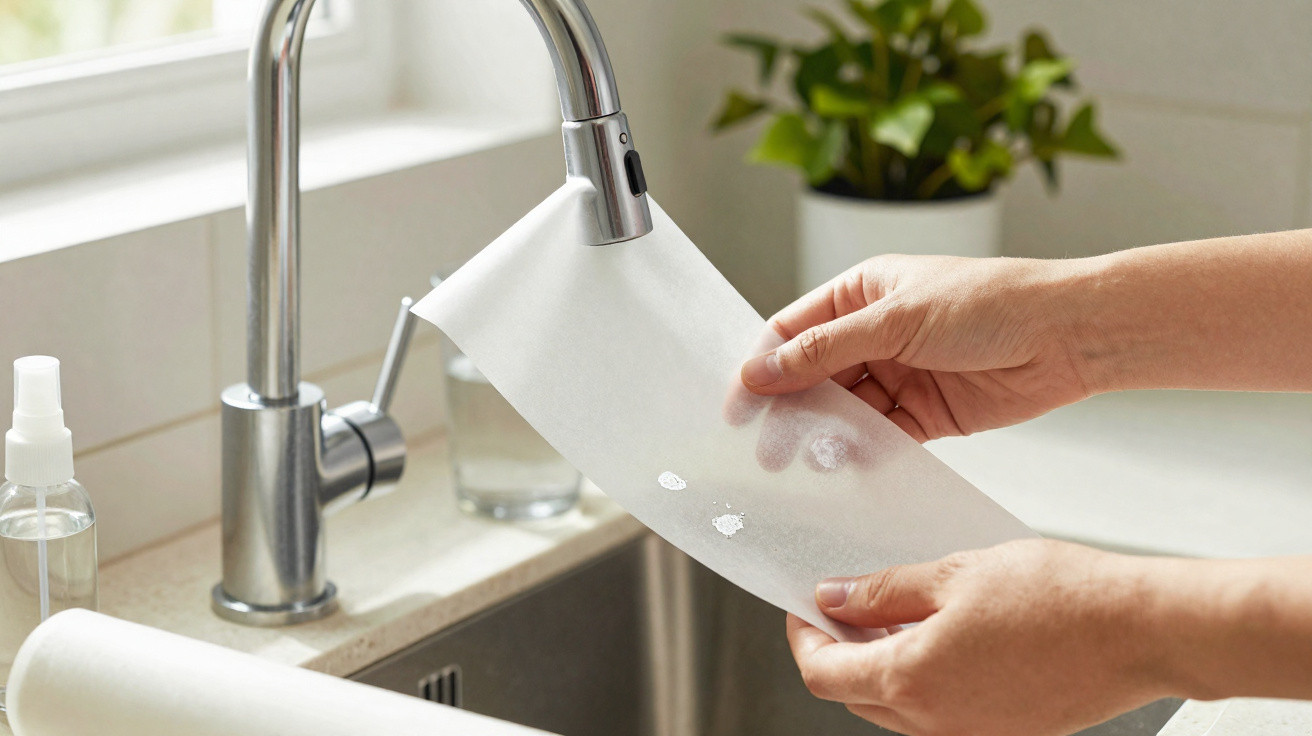
This is where an unusual idea comes in: baking paper, normally used to line trays and stop cakes or vegetables from sticking. The paper has a slightly smooth, coated surface. On dry chrome or stainless steel, it performs two functions at once.
First, it rubs away fine limescale haze and light water marks without leaving scratches. Second, rubbing it over the surface creates an ultra-thin water-repellent layer on the tap. Water droplets bead up more readily, spread out less and dry faster, rather than remaining behind as marks.
Many users report that, after this treatment, the tap stays visibly clean for five to seven days – substantially longer than after an ordinary wipe with a washing-up cloth.
How to use the baking paper method step by step
For the trick to work properly, the order matters:
- Dry the tap thoroughly: Use a clean microfibre cloth to remove all remaining water, including around the base, handle and joints.
- Prepare the baking paper: Scrunch one sheet into a soft ball. This creates a larger rubbing surface.
- Polish gently: Run the paper ball over the spout, handle, base and, if applicable, the hand shower. Light pressure is enough; allow around one minute for the entire tap.
- Finish with a wipe: Give it a final quick polish with a dry microfibre cloth. This helps distribute the protective layer evenly.
The method works best on smooth, shiny surfaces such as classic chrome or polished stainless steel. With black or matt taps, first test an inconspicuous area to see whether the appearance changes. Extra care is advisable around natural stone, such as marble or travertine, to prevent the coated paper from coming into contact with the sensitive surface.
Start by removing heavy limescale
If taps are heavily affected by limescale, do not begin immediately with baking paper. Start with an intensive deep clean instead. The paper routine can only deliver its full effect once thick deposits have been removed.
Typical steps for an effective start include:
- unscrewing the aerator and soaking it in warm vinegar water for several hours
- treating badly affected areas with vinegar, lemon juice or a bicarbonate of soda paste
- allowing the product to work, then rinsing thoroughly with water
- drying the tap completely afterwards
Once the original shine has largely returned, a brief baking paper treatment once a week is often enough to maintain the result. This pushes the next major descaling session much further into the future – while reducing the amount of specialist cleaner in the cleaning cupboard.
“Baking paper does not replace an initial deep clean, but it noticeably extends the ‘freshly cleaned’ phase afterwards.”
How to fit the method neatly into everyday life
With a well-planned routine, this extra care takes almost no additional time. It is useful to keep a piece of baking paper close to the sink or basin. After washing up or brushing your teeth, simply dry the tap briefly, then run the paper over it for a few seconds.
Supporting habits can enhance the effect:
- quickly wipe down the tap with a microfibre cloth after showering
- remove the aerator every few weeks and rinse it under running water
- check the spray pattern: blocked nozzles cause more spotting
People living in areas with very hard water may also consider aerator attachments that encourage water to bead, or a central water treatment system. Such systems cost more, but they reduce the strain not only on taps, but also on washing machines, boilers and dishwashers.
Where the baking paper method reaches its limits
As clever as this trick may sound, it is not a cure-all. Baking paper will not remove thick, old limescale crusts. Nor can it “polish away” discolouration or chrome plating that has already been damaged. In these cases, only conventional cleaners or, in the worst case, replacing the tap will help.
The technique is also unsuitable for every surface. Coated, coloured and highly delicate materials react differently to friction. Anyone with high-end designer taps should check the manufacturer’s care instructions and use only gentle pressure.
How baking paper works alongside other household remedies
The trick becomes particularly useful when combined with familiar household remedies. One possible system that works well in many homes is:
| Interval | Action |
|---|---|
| daily | Dry the tap briefly with a microfibre cloth |
| once a week | Use baking paper to polish and create the protective layer |
| every 4–8 weeks | Descale with vinegar, lemon juice or bicarbonate of soda if needed |
This can substantially reduce the use of standard anti-limescale sprays without making the sink, basin or shower look neglected. For families with children or pets, using fewer aggressive cleaning products is an additional advantage.
Why hard water is more than a cleaning issue
Behind unattractive marks lies a technical problem: hard water puts strain on all pipes and appliances. Deposits form on the heating elements in dishwashers and washing machines, consuming energy. Limescale builds up in shower heads and changes the water flow. Even coffee machines and kettles scale up faster and have a shorter lifespan.
By observing taps more closely, households can also gain an impression of the general water hardness in their home. Heavy spotting on a tap usually indicates greater strain on appliances too. Regular descaling can significantly extend their service life – in this context, baking paper is more of a bonus for appearance and reduced cleaning effort.
Practical tips for everyday use
No specialist brand is needed to try this trick: ordinary baking paper from the supermarket is sufficient. Silicone-coated versions usually work better than very thin, uncoated papers. The key is that the surface feels slightly smooth rather than rough and fibrous.
For households aiming to produce as little waste as possible, the question of reuse naturally arises. One sheet can generally be used several times, provided it stays clean and does not tear. Once it can no longer be used, it belongs in general waste – unlike kitchen roll, which often goes into paper recycling.
Anyone who likes the method can prepare a small “polishing ball” from baking paper and store it in a dry container in the bathroom or beneath the sink. That turns an internet hack into a genuine everyday habit – and makes looking at the tap far less frustrating.
Comments
No comments yet. Be the first to comment!
Leave a Comment