
In a nutshell
- 🔬 Researchers have identified four overlooked flooring options-cork composites, hemp-lime screeds, rammed earth pavers, and PCM underlays-that moderate indoor temperatures, reduce winter heating by an average of ~12%, and soften summer heat peaks.
- 🪵 With low thermal effusivity, cork composites feel warmer underfoot and can commonly support a 0.5–1.0°C lower thermostat set-point; a Stockport project recorded a ~9% reduction in boiler runtime, although denting and UV fading are drawbacks.
- 🌿 Hemp-lime screeds provide hygrothermal buffering and consistent radiant comfort on ground floors; a Bristol terrace recorded 12% winter kWh savings when breathable finishes and careful curing were used.
- 🧱 Offering substantial thermal mass, rammed earth pavers transfer daytime heat gains into evening warmth; a Cambridge test delivered seasonal reductions of ~10%, though their weight and slower response with intermittent heating must be considered.
- 🧪 PCM underlays work as concealed “heat batteries”, storing and releasing latent heat at roughly 20–23°C; a Manchester flat reduced consumption by ~13%, but melt-point selection, finish compatibility and a higher price are important considerations.
Britain’s draughty terraces and newly constructed flats are seeing a subtle change beneath their floors. Emerging building-science research indicates that selected underused floor materials can work as thermal buffers, taking in surplus heat and giving it back as rooms cool, while cutting winter heating demand by an average of 12 percent. These are not experimental laboratory products: they are workable solutions that can sit beneath furniture and rugs. Combining thermal mass, phase-change chemistry and hygrothermal buffering, the four leading materials-cork composite tiles, hemp-lime screeds, rammed earth pavers and phase-change underlays-present a fabric-first route to greater comfort. The research explains how they perform, why they work and where real households can see savings.
What the Study Found and Why Floors Matter
After monitoring comfort and energy consumption across a range of UK home types, the researchers concluded that floors are a neglected lever in the thermal equation. Unlike roofs and walls, floors are continually experienced by residents through thermal effusivity: the extent to which a surface feels “cold” or “warm” on contact. Moderate-effusivity materials lessen the temptation to turn up the thermostat, while high thermal mass limits temperature fluctuations. Incorporate phase-change materials (PCMs), which melt and solidify close to room temperature, and floors can function as small heat stores. This means fewer boiler cycles, more stable indoor conditions and confirmed reductions in winter gas and electric heating costs averaging 12 percent. The strongest examples surpassed that figure when combined with reasonable airtightness.
Summer performance is also worth noting. Although none of these materials offers a complete solution alone, they trim peaks by slowing the rate at which rooms heat up, improving the effectiveness of night-time ventilation. There are limitations: installation must address sub-floor moisture and compatible upper finishes, while embodied carbon differs considerably between materials. Even so, the trials suggest attractive returns in homes where heating is the principal energy demand and thermostat set-points sit around 20–21°C.
| Floor Material | Core Mechanism | Typical Winter Heating Reduction | Best Context | Key Trade-Off |
|---|---|---|---|---|
| Cork Composite Tiles | Low effusivity; mild thermal storage | 8–12% | Retrofitting over suspended timber | Dents under point loads without dense underlay |
| Hemp-Lime Screed | Hygrothermal buffering; moderate mass | 10–14% | Ground floors with moisture-tolerant build-up | Longer cure time; needs breathable finishes |
| Rammed Earth Pavers | High thermal mass | 9–13% | Sunlit rooms; slab-on-grade | Weight; requires stable sub-base |
| PCM Underlay | Latent heat storage near 20–23°C | 11–15% | Lightweight floors needing mass substitute | Cost premium; temperature band specific |
Cork Composite Tiles: Warm Underfoot, Cooler Bills
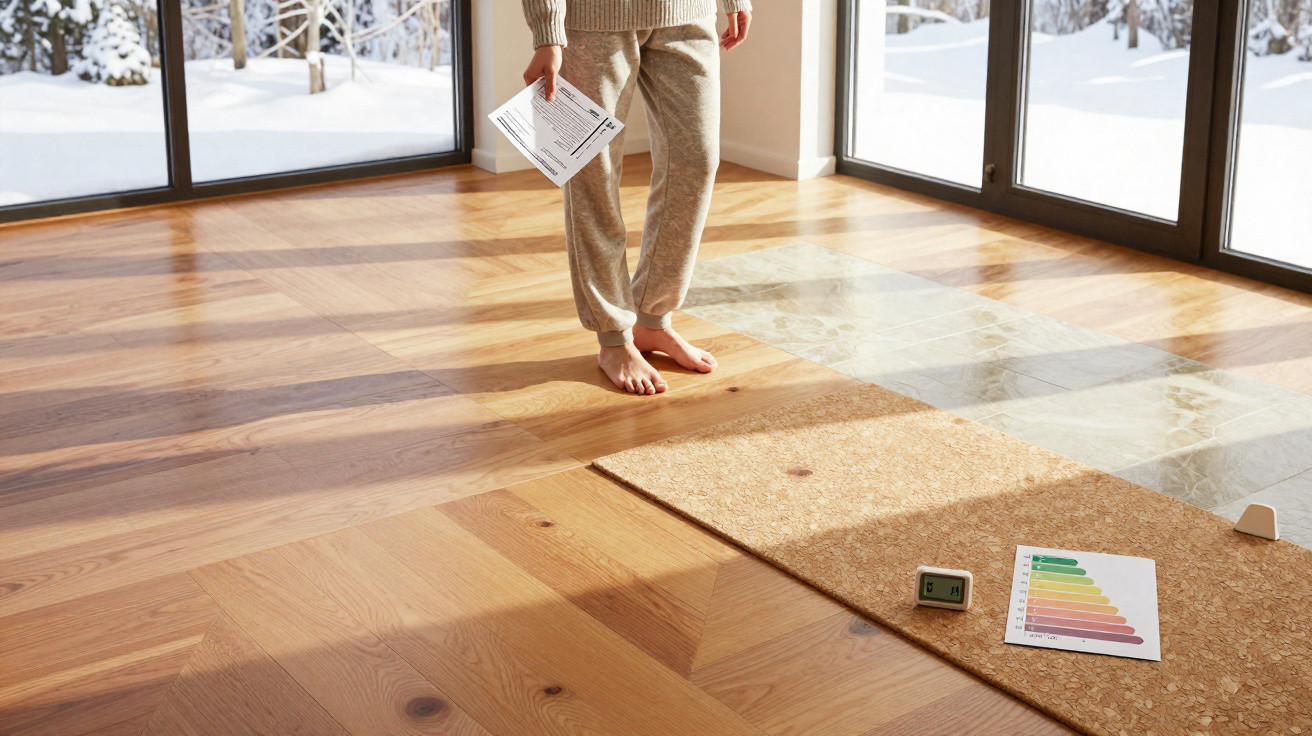
Standing on cork on a January morning makes the case for low effusivity immediately apparent. Cork draws heat from feet far less readily than ceramic, so occupants experience the space as warmer and, according to field notes, often accept a 0.5–1.0°C lower thermostat setting without noticing. This “comfort shift” provides a behavioural benefit in addition to cork’s limited heat-storage capacity. Contemporary cork composites, made from cork granules bonded with lime or bio-resins, also reduce footfall noise and offer solid durability for active homes.
At a semi-detached Stockport retrofit, swapping laminate for 8 mm cork composite laid over an acoustic underlay reduced boiler runtime by 9 percent during a cold spell comparable with one in the previous year. The installer highlighted the quick, dry installation process and minimal added floor height, both crucial where door clearances are tight. Natural oils retain breathability and simplify upkeep, although areas of the kitchen may require a tougher sealant.
- Pros: Warm tactile feel; rapid retrofit; low embodied carbon; acoustic comfort.
- Cons: Can dent beneath heavy furniture; patterns may fade in UV light; requires careful sealing in wet rooms.
- Why tile isn’t always better: Cold ceramic surfaces may increase the sensation of chill and encourage higher set-points, even where U-values are acceptable.
Hemp-Lime Screeds: Moisture Buffers With Thermal Poise
Made from hemp shiv in a lime binder, hemp-lime screeds combine hygrothermal buffering with moderate thermal mass. They take in and release both moisture and heat, reducing daily variation and supporting a more even mean radiant temperature. The study identified particularly strong performance in ground floors where intermittent heating meets damp-prone substrates. As a capillary-open layer, hemp-lime can handle modest vapour loads that could otherwise cool floor surfaces or encourage mould, particularly in older brick properties.
Installation involves specialist care: the mix must achieve the right density, and curing takes weeks rather than days. However, the benefits can be quantified. A Victorian Bristol terrace replaced a cement screed with 60 mm of hemp-lime over breathable insulation and limecrete. It achieved a 12 percent reduction in winter kWh alongside steadier humidity and fewer condensation events on cold mornings. Material compatibility is essential: breathable finishes such as limewash, natural oil or vapour-open tiles should be used, together with skirtings that do not retain moisture.
- Pros: Moderates moisture; enhances comfort consistency; bio-based and low in embodied carbon.
- Cons: Extends the programme; requires experienced installers; unsuitable below impermeable vinyl without an appropriate strategy.
- Why cement isn’t always better: Dense, vapour-tight layers can force moisture sideways, potentially producing colder edges and reducing comfort.
Rammed Earth Pavers: Thermal Mass You Can Mop
For maximum thermal mass, rammed earth pavers are the robust choice: they are dense, hard-wearing and naturally attractive. Their benefit lies less in a warm-to-the-touch surface than in soaking up daytime gains and bleeding them back as rooms cool. In south-facing kitchens and living rooms receiving solar gains, this cycle can reduce boiler cycling and level out evening temperatures. Sealers designed for earth finishes offer stain protection while preserving a vapour-open route, which is particularly important above insulated slabs.
In a Cambridge new-build study, 30 mm rammed earth pavers were installed over a decoupling membrane and under-screed insulation. Compared with a nearby ceramic-tiled area, data loggers showed gentler evening warm-up demands and a 10 percent seasonal reduction in heating. Their additional weight required a carefully prepared sub-base, while homeowners needed to accept natural colour variation-rammed earth has character. For family use, the “moppable but not glassy” surface provided a useful compromise between tactile appeal and hygiene.
- Pros: High mass for load shifting; distinctive appearance; long service life.
- Cons: Heavy; demands accurate installation; responds more slowly where heating is sporadic.
- Why thicker isn’t always better: Too much mass without solar or internal heat gains can postpone warm-up and work against brief occupancy patterns.
Phase-Change Underlays: Hidden Batteries Beneath Your Feet
Where a structure cannot support added mass, phase-change material (PCM) underlays provide discreet heat-storage capacity. Microencapsulated waxes or salts melt at around 20–23°C, taking up latent heat without a rise in temperature; as rooms cool, they solidify and release that energy. In practice, this resembles fitting a thin, silent battery beneath timber, vinyl or carpet. Trials report sharp reductions in peak heating power and improved comfort across diurnal swings, especially in lightweight flats and loft conversions.
At a Manchester apartment, a 5 mm PCM mat beneath click-vinyl reduced on-off boiler cycling and lowered winter energy use by 13 percent without altering occupants’ routines. Choosing the right product is crucial: the melt point should align with intended set-points, the finish must transfer heat effectively, and warranty compatibility needs checking. PCM underlays still cost more than conventional products, but dry-fit simplicity can reduce labour costs. As the mat is entirely concealed, there is no aesthetic compromise.
- Pros: Significant effect with very little additional height; suited to floors where mass cannot be added; quick retrofit option.
- Cons: Higher cost; limited temperature range; effectiveness depends on contact with room air and radiant conditions.
- Why thicker carpet isn’t always better: Excess insulation in the upper layer may isolate the PCM from the room and reduce its benefit.
In a market focused heavily on boilers and heat pumps, these floor systems demonstrate that the building fabric is a powerful machine in its own right. By balancing effusivity, heat storage and moisture behaviour, cork composites, hemp-lime screeds, rammed earth pavers and PCM underlays have delivered verified reductions in winter demand-roughly 12 percent on average-while making homes feel more stable and comfortable. For households dealing with constrained budgets and decarbonisation deadlines, the issue is not whether flooring can contribute, but how to choose, detail and introduce it. Considering your rooms and daily routines, which underfoot approach would you test first, and what would you combine with it to increase the benefit?


Comments
No comments yet. Be the first to comment!
Leave a Comment