
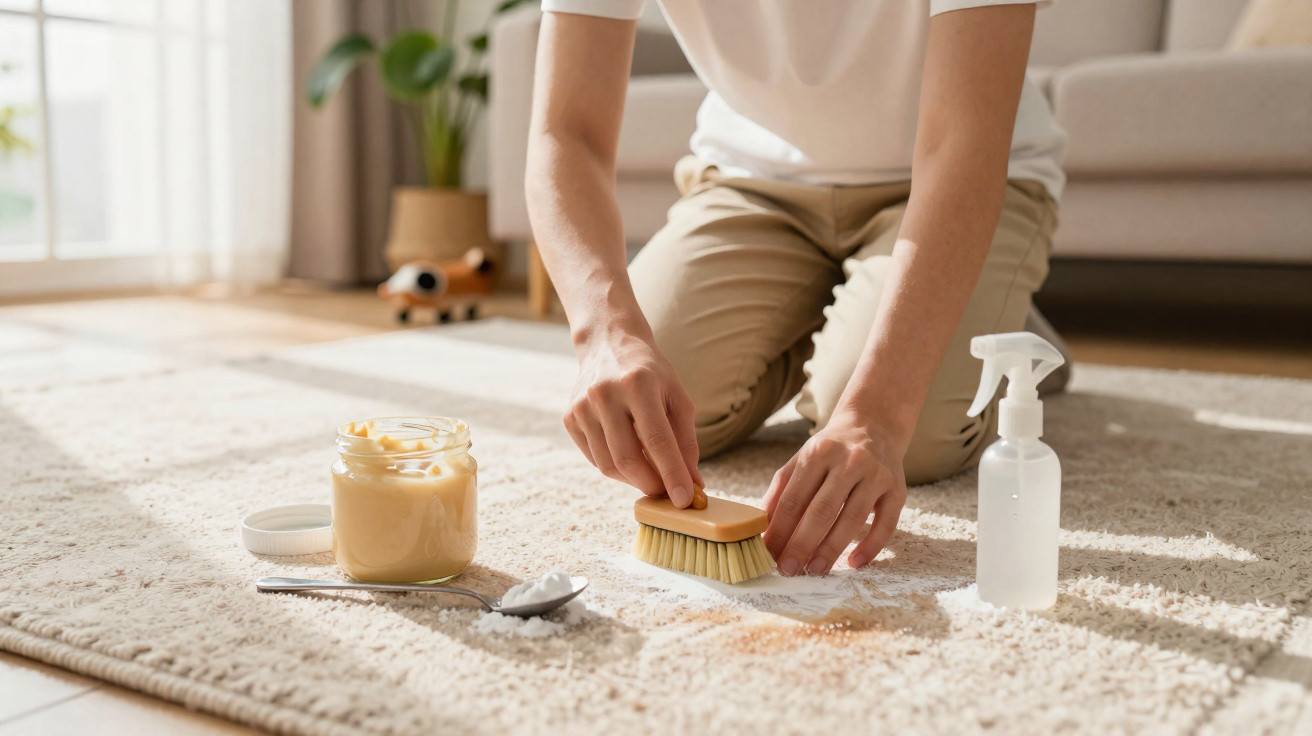
Many households know the issue: carpets start to look grey, develop a slight musty smell, and expensive specialist cleaners fail to deliver. A mixture of two simple ingredients is now circulating on cleaning forums, said to lift stains, neutralise odours and visibly refresh carpets – without relying on costly harsh chemicals.
Why household products are so popular for carpets
Ready-made carpet cleaners from shops make big promises, but they are often expensive, harsh and unsuitable for some materials. This is why many people are returning to methods that previous generations used: simple cupboard staples combined in the right way.
A homemade paste made from kitchen ingredients can clean carpets, revive colours and remove musty odours in a short time.
The main benefit is that you know exactly what the cleaning product contains, can adjust the quantity and save a considerable amount of money over time – particularly if you have several carpets at home.
How to make the two-ingredient carpet paste
This method is based on a reaction between two common household products. It creates a gently foaming paste designed to draw dirt from the fibres.
Recipe for the carpet paste
- 2 tablespoons bicarbonate of soda (baking soda)
- 1 tablespoon clear household vinegar
- Optional: a little hot water
- Optional: 1 drop of mild washing-up liquid for greasy stains
Combine the bicarbonate of soda and vinegar in a small bowl. The mixture will immediately start to foam slightly – this reaction is what helps loosen dirt and deposits. If desired, add a few drops of hot water and a little washing-up liquid, especially for greasy or sticky marks.
It is important that the paste remains thick and mouldable. It should not be runny like water. It needs to sit on the fibres rather than soaking completely into the carpet.
How to identify the right consistency
The mixture has the ideal texture when it:
- spreads easily with a spoon;
- does not run by itself;
- remains “on” the fibres without soaking through to the backing.
If you have added too much water, simply mix in more bicarbonate of soda until the paste becomes firmer again.
Step by step: applying the paste to a carpet
Preparation: vacuuming is essential
Before applying the paste, remove any loose dirt from the carpet. Vacuum it thoroughly first, ideally working slowly in strip by strip. This prevents dust and crumbs from sticking in the paste and creating a greasy film.
Applying the paste correctly
- Pick up the paste with your fingers or the soft side of a sponge.
- Smooth it gently over the affected area, following the direction of the pile.
- Do not scrub or “rub it in” – the paste should rest on the surface rather than being pressed deep into the fabric.
The top layer of the fibres absorbs the mixture. After a few minutes, it begins to dry and can get to work. Many people notice that the paste changes colour slightly; this indicates that it is binding dirt.
Contact time and removing the residue
Leave the paste on the area for around 15 to 20 minutes. During this period, it loosens stains, captures odours and absorbs moisture.
Afterwards:
- Carefully lift away the dried residue using kitchen roll or a mop.
- Allow the carpet to air-dry completely.
- Finish by vacuuming thoroughly to remove every last crumb.
The key to a good result: use little water, work gently and vacuum thoroughly after treatment.
When the whole carpet can be treated with paste
This approach is particularly suitable for smaller or hard-wearing carpets, such as:
- bathroom mats;
- kitchen rugs;
- synthetic hallway runners;
- polyester or polypropylene carpets.
For these types, the paste can be spread in a very thin layer across the entire surface. The soft side of a sponge or a damp cloth works well for this.
The carpet will absorb part of the paste while the rest dries on the surface. The remaining residue can then be removed with a cloth. Colours appear clearer, and the typical grey “walkway” in an entrance area becomes noticeably less visible.
Only an odour, but no stains? Bicarbonate of soda alone is enough
If a carpet looks clean but smells musty, there is no need to mix a paste. In many cases, bicarbonate of soda on its own will do the job.
Neutralising odours with dry bicarbonate of soda
- Vacuum the carpet lightly.
- Sprinkle a thin, even layer of bicarbonate of soda over the surface.
- Distribute it gently by hand.
- Leave it to work for at least 30 minutes; for strong odours, leave it for several hours or overnight.
- Vacuum everything up thoroughly.
Bicarbonate of soda binds odours, absorbs excess moisture and gently loosens the fibres. This makes the carpet feel fresher and softer without any wet cleaning.
When large packs of bicarbonate of soda are worthwhile
Many shoppers are frustrated by tiny packets of bicarbonate of soda from the supermarket that are empty after only two uses. Anyone who regularly treats carpets, mattresses, sofas or the fridge with bicarbonate of soda will find larger packs much better value.
Chemists often sell bicarbonate of soda in 1 kg packs, while online retailers commonly offer bags containing several kilograms – similar to laundry powder. As well as carpets, the powder can be used for grout, sinks, ovens or shoes. A bulk pack therefore usually pays for itself quickly.
Common mistakes when cleaning carpets with household products
Too much water and too little patience
The most common mistake is making the paste too runny. The carpet then becomes saturated, dries poorly and may develop edges or yellowish discolouration. The treated area should look only slightly damp, never soaked.
Another classic error is vigorous scrubbing. Rubbing hard pushes dirt further into the fibres and makes the stain larger. It is better to apply the paste calmly, allow it to work, remove the residue and then vacuum.
The wrong material for vinegar
Vinegar is not suitable for every carpet. The following are particularly sensitive:
- wool carpets;
- viscose carpets;
- oriental carpets;
- carpets made from delicate natural fibres.
For these items, vinegar can alter the colour, leave the surface dull or actually “attack” the fibres. Only dry methods should be used here – such as bicarbonate of soda powder and, if anything, a very well-wrung cloth.
The vinegar and bicarbonate of soda paste described here is primarily intended for synthetic carpets, commonly found in kitchens, bathrooms and hallways.
How safe is the method, and what should you consider?
Bicarbonate of soda and clear household vinegar are considered comparatively mild products. Especially in homes with children or pets, many people prefer them to aggressive sprays. Even so, a few points remain important:
- Always test the mixture on an inconspicuous corner first.
- Do not use coloured vinegar; use clear vinegar only.
- Ventilate rooms well until the vinegar smell has disappeared.
- Keep pets’ paws away from damp areas until everything is dry.
Anyone with very high-value carpets or any uncertainty can hire a professional for individual stains and reserve the bicarbonate of soda method for everyday runners.
Practical examples: where the paste is especially useful
Typical areas for use are heavily used spaces: a hallway runner, a bathroom mat, a kitchen runner in front of the sink, or carpets in a child’s bedroom. These areas quickly pick up stains from shoes, food, cosmetics or pets.
The paste works particularly well where surface dirt and odours are the issue: dried-on marks, slightly grey traffic areas and mild pet smells. It has its limits with old red wine stains or deeply absorbed coffee – in such cases, it is more likely to reduce the stain than make it invisible.
Repeating the treatment at regular intervals helps prevent stubborn dirt from building up. Combined with thorough vacuuming, it keeps carpets looking presentable for longer without constantly needing expensive specialist cleaners.
Comments
No comments yet. Be the first to comment!
Leave a Comment