
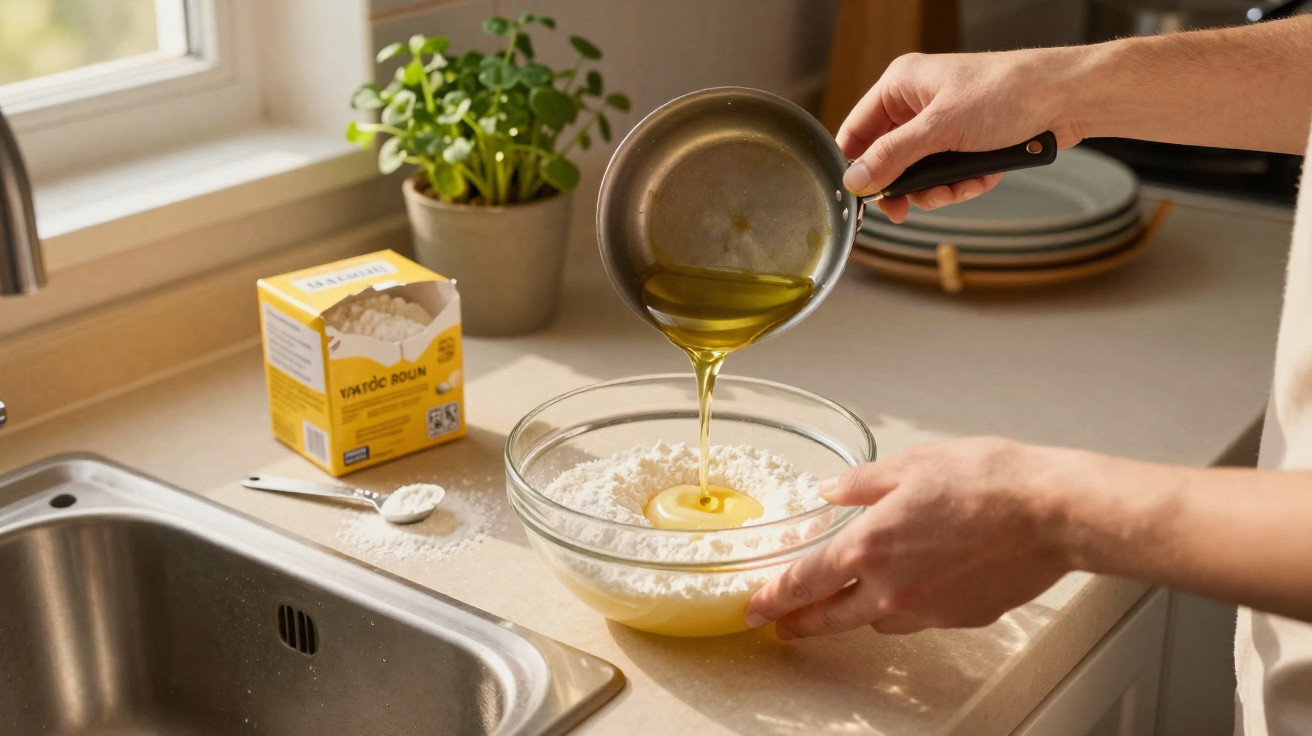
A simple cupboard ingredient can make all the difference.
When cleaning the frying pan after frying schnitzel or deep-frying, most people look for the quickest option. Used oil may seem harmless: it disappears down the plughole and out of sight. In fact, that is where a problem begins, often only becoming apparent weeks later when the drain gurgles, smells unpleasant or becomes completely blocked. An unremarkable powdered ingredient from the kitchen cupboard can prevent this headache – without chemicals, drain cleaner or an emergency plumber.
Why your kitchen sink really “hates” cooking oil
Deep-frying oil and cooking fat can be deceptive. While still hot, they flow smoothly through the strainer and down the drain. Once inside the pipe, however, the fat meets cold water and cools very quickly.
“Liquid fat turns into a sticky film inside the pipe, building up layer by layer into a solid plug.”
This film is precisely the issue: it sticks to the pipe walls and traps food scraps, hair, coffee grounds and anything else that subsequently travels through the pipework. This can result in:
- slow-draining water
- unpleasant odours from the trap
- in severe cases, a complete blockage with water backing up
Plumbing firms have reported for years that a large proportion of call-outs to city flats are caused by fat in the pipes. Residents often notice nothing for a long time – until water suddenly remains in the sink and an emergency call-out is needed.
There is also an environmental consideration. Wastewater treatment plants can develop veritable “fatbergs” from fat and other residues, which have to be removed with considerable effort. This uses energy and staff time, while placing pressure on infrastructure. Less oil down the drain therefore also means less strain on municipal systems.
The simple kitchen powder solution
Rather than pouring fat into the sink, you can turn it into a solid lump with an everyday kitchen ingredient and dispose of it with normal residual waste. The key is a starchy or fine powder, such as cornflour.
“A dry powder with a high starch content absorbs the fat and binds it into a semi-solid mass that can no longer flow.”
The fine particles contain numerous tiny spaces. They soak up the oil like a sponge and combine with it to form a paste that becomes substantially firmer within a few hours. A slippery liquid that is difficult to control becomes a solid residue that cannot reach the pipework.
Unlike hot water or harsh drain cleaners, this approach does not simply move the issue elsewhere: it prevents it. There is no need to handle boiling water or use strong chemicals that may later end up in rivers and lakes – just a harmless kitchen product.
Step-by-step guide: how to bind used cooking oil
The method could hardly be easier, but two things matter: temperature and patience.
What you will need
- used cooking oil or frying fat, for example from a frying pan or deep-fat fryer
- 1–2 tablespoons of a fine kitchen powder, such as cornflour
- a jar or another sealable container
- a spoon for stirring
Method
- Allow it to cool: Let the fat cool down a little after cooking. It can be lukewarm, but it must never still be steaming hot.
- Pour it into a container: Transfer the lukewarm oil to a jar or an old plastic container that you intend to throw away anyway.
- Add the powder: Scatter 1–2 tablespoons of powder evenly across the surface, then stir it in slowly.
- Wait for it to thicken: Continue stirring until the liquid becomes noticeably thicker. Then seal the container.
- Leave it to stand: Put the container aside at room temperature for at least several hours, ideally overnight.
- Dispose of it: By the following day, a compact mass will have formed, which can be placed in the residual waste bin together with its container.
If you deep-fry regularly or do a lot of pan-frying, use an old screw-top jar as a dedicated collection container, adding layers of fat and powder over time. Once the jar is full, dispose of it in the bin while sealed.
No cornflour at home? These alternatives work too
Many kitchens contain other powders that absorb fat just as effectively. The important thing is that they are as fine, dry and absorbent as possible.
| Product | Suitability for binding fat | Note |
|---|---|---|
| Plain flour | good | available almost everywhere; binds slightly more slowly |
| Baking powder or dried yeast | good | fine texture; mixes well with oil |
| Fine food starch, for example rice or potato starch | very good | produces an effect similar to cornflour |
| Arrowroot | very good | binds particularly quickly; often found in gluten-free kitchens |
| Coffee grounds, dried | moderate | environmentally friendly, but coarser and less even |
| Fine wood shavings / sawdust, untreated | moderate to good | suitable only when free from varnishes or chemicals |
Those who prioritise sustainability can be inventive here. What matters is that the powder is dry. Damp coffee grounds, for example, should be air-dried before use so that they can absorb the oil at all.
Why this method protects both your pipes and the environment
Fat poured down the drain does not simply disappear. In the sewer system, fats react with limescale and other substances to form solid lumps. Local authorities must remove these deposits with significant effort, increasing both costs and energy consumption.
“Every gram of fat that goes into residual waste rather than the pipework reduces the burden on sewers, wastewater treatment plants and, ultimately, rivers and lakes.”
Binding your cooking oil therefore reduces several pressures at once:
- a lower risk of blocked pipes in your own home
- less need for aggressive drain cleaners
- reduced formation of fat deposits in the urban sewer network
- less work and energy use at wastewater treatment plants
There is a financial benefit too: avoiding a single emergency plumber call-out can easily save a three-figure sum. A spoonful of powder, by contrast, costs only a few pence.
How to make the cooking oil trick part of your kitchen routine
The biggest obstacle is not the technique but habit. Many people act automatically while washing up, especially when they are in a hurry. Two straightforward measures can help establish the new routine:
- Keep a jar for fat leftovers in a visible place beside the hob.
- Store the cornflour or another powder right next to it.
- Always pour fat into the jar first – never into the sink.
- Set aside a regular moment to mix it after cooking, such as while clearing the table.
After a few weeks, this step will no longer feel like “extra work”; it will simply become part of cooking, much like airing the kitchen after frying.
What else you should know about used cooking oil
If you have large quantities of used deep-frying oil, also check the local collection points available in your area. Many waste services provide containers for old cooking oil, which can be collected and processed into biodiesel or other products. For small amounts from a frying pan, the powder-binding method is entirely sufficient.
Important: never pour burning or very hot fat into a container. There is a risk of burns, and the container could melt or burst. The oil is cool enough for the next step only once you can touch the pan without using an oven glove.
The powder trick is also useful at campsites and in holiday lets, where drains are often more sensitive. Packing a small bag of cornflour can prevent more than one unpleasant surprise on the final day of a holiday.




Comments
No comments yet. Be the first to comment!
Leave a Comment