
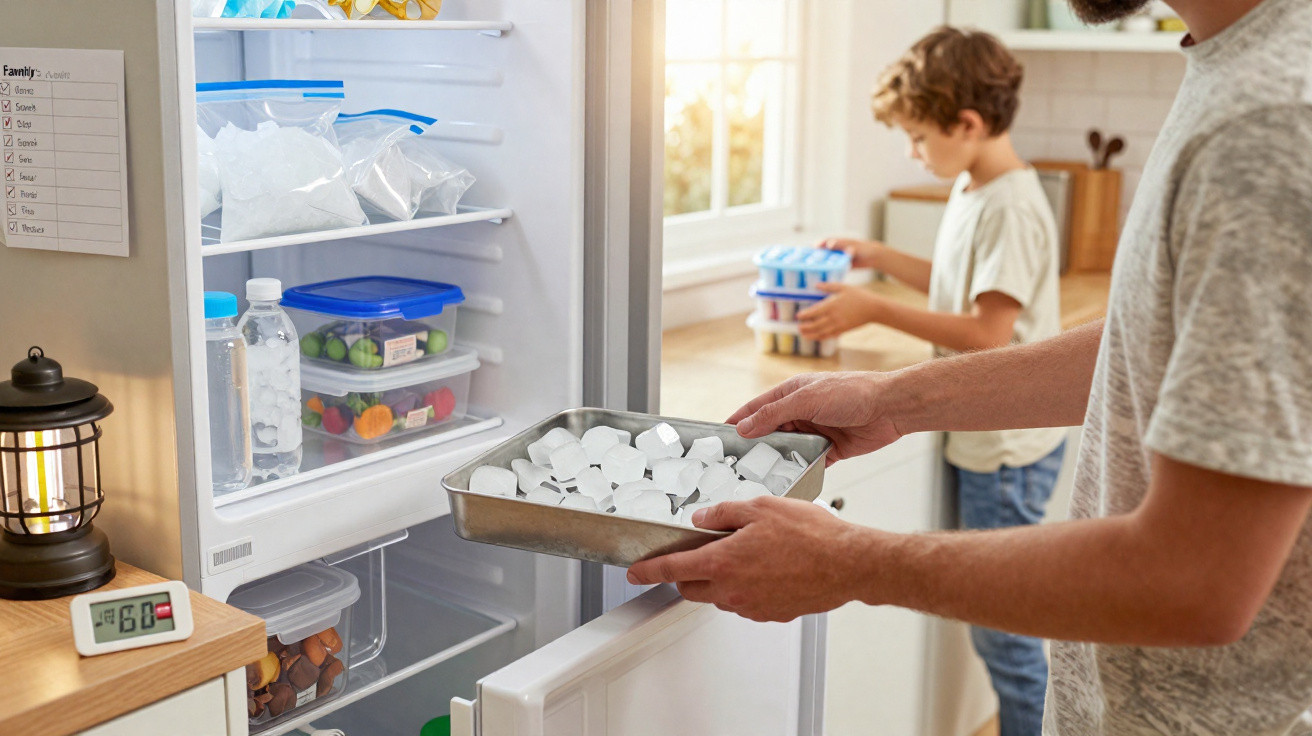
Being prepared helps protect your family from spoiled food.
European health authorities warn that even a few hours without electricity may be enough for food to spoil, creating a risk of gastrointestinal infections. Two figures are crucial - four hours and five degrees - alongside one unexpectedly simple aid: keeping a good supply of ice.
Why a power cut can quickly become a health risk
When electricity fails, nearly everything in a modern home stops working: lighting, heating pumps, internet access - and, importantly, refrigeration appliances. While candles and power banks are relatively easy to prepare, the risks inside the fridge are often overlooked.
Recent guidance developed with several European authorities clearly identifies the danger: rising temperatures and elapsed time. Once the power is off, both can be controlled only to a limited extent.
After around four hours without power, an ordinary refrigerator may no longer be able to maintain a safe temperature.
Above 5 °C, many bacteria thrive and multiply rapidly. This is particularly true for sensitive foods including meat, fish, cold meats, eggs, dairy products and prepared meals.
The ‘four-hour rule’ for the fridge
The most important immediate response to a power cut may sound obvious, but it is vital: keep the doors shut.
- Keep the refrigerator and freezer doors firmly closed.
- Open them only when absolutely necessary, and act quickly when you do.
- Monitor the temperature using a fridge thermometer.
A closed refrigerator generally stays within a safe range for about four hours. After that, the internal temperature rises noticeably, especially if it is only half full or the room is warm, such as during summer or in heavily heated kitchens.
The difficulty is that spoiled food cannot always be identified by its smell or appearance. Many harmful germs leave no obvious signs, yet they can cause stomach upsets, diarrhoea, vomiting or, in severe cases, serious infections.
Ice as an emergency reserve: protecting your food supplies
This is where a tip that may initially seem unusual becomes useful: store ice in reserve. A few fully frozen containers can decide whether a prolonged power cut means throwing away much of the food in your fridge or saving it.
Several containers of ice in the freezer act as cold stores in an emergency, significantly extending the safe time in the refrigerator.
Practical options for your ‘cold emergency plan’ include:
- Fill empty plastic bottles to roughly 90 % with water, freeze them and keep them in the freezer permanently.
- Freeze water in freezer-safe boxes or containers; flatter shapes cool particularly effectively.
- Re-freeze and keep ready the cool packs used for camping cool boxes or picnic boxes.
- Use bags of ice cubes for flexible, smaller cold reserves.
If the power fails, move some of these ice blocks or cool packs from the freezer compartment into the refrigerator. They lower the temperature and can gain valuable extra hours. It remains important to open the door only briefly and to place the ice containers together rather than separately wherever possible.
Freezer: more time, but not a free pass
Frozen foods have a clear advantage, as they tolerate a power cut for much longer. If a freezer is full and remains closed, it can retain cold temperatures for up to 48 hours. When it is only half full, that period falls to around 24 hours.
What matters most:
- Keep the appliance as full as possible, including with frozen water bottles or ice blocks.
- Stack items closely together so that they help keep one another cold.
- Keep lids and doors strictly shut.
There is another useful benefit: a very full freezer is not only more effective in an emergency, but also more economical during normal use because less warm air enters when it is opened.
What should you do if frozen food starts to thaw?
As soon as food is no longer completely solidly frozen, the question arises: is it still safe, or has it become risky?
- If the food is still ice-cold but has thawed slightly, it can generally be used promptly.
- Refreezing is not advisable because flavour and texture deteriorate, and germs may already have started multiplying.
- Heating food thoroughly before eating it - by boiling or frying, for example - reduces the risk further.
Above 5 °C it becomes critical: these foods should be thrown away
One clear rule of thumb makes the decision easier: perishable food kept at temperatures above 5 °C for more than two hours should be discarded. This applies in particular to:
- raw meat, minced meat and cold meats
- raw or thawed fish and seafood
- milk, yoghurt, cream and soft cheese
- ready-cooked dishes and sauces
- beaten eggs, egg dishes and mayonnaise products
When in doubt, throw it away - the cost of food poisoning is higher than a full bin.
Warning signs that mean food should be disposed of immediately include:
- an altered, unfamiliar or strong smell
- discoloured patches, a slimy coating, or greyish or greenish colouring
- swollen packaging on dairy products or ready meals
- liquids that foam or hiss when opened
Following a lengthy power cut, inspect every part of the fridge and freezer carefully. Any area where liquid has leaked or mould is present needs thorough cleaning with warm water and washing-up liquid or a mild household cleaner.
Food supplies that do not need refrigeration
Anyone preparing for a possible energy crisis should think not only about candles and batteries, but also about sensible food stores. The aim is to manage for several days or weeks without refrigeration, without having to live solely on pasta with ketchup.
| Category | Suitable products |
|---|---|
| Staple foods | Rice, pasta, porridge oats, flour, pulses |
| Tins and jars | Beans, lentils, tomatoes, sweetcorn, tinned fish, stews |
| Long-life dairy products | UHT milk, condensed milk, long-lasting cheese such as hard cheese |
| Snacks and energy foods | Nuts, cereal bars, dried fruit, rusks, crispbreads |
| Drinks | Mineral water, shelf-stable juices, tea, coffee |
These supplies can be built up gradually by buying one extra item at a time and following the principle of using the oldest products first.
How to keep your family organised during a power cut
A sound plan reduces stress when everything suddenly goes dark. Even a brief family discussion can ensure that everyone knows what they need to do.
- Who is responsible for candles, torches and power banks?
- Who keeps track of the time and duration of the outage?
- Who decides when particular foods should be used or thrown away?
A small list fixed to the fridge is practical, covering the most important rules: the four-hour limit, the 5 °C threshold, ‘keep the door shut’ and ‘when in doubt, throw it away’. This prevents anything being forgotten in the rush.
Common misconceptions - and the truth
- “If it does not smell bad, it is still fine.” Wrong. Many dangerous germs barely change a food’s smell or appearance.
- “Boil it thoroughly once and it will be all right.” Heat does kill many bacteria, but not every toxin they may already have produced.
- “Frozen food always keeps.” Only while it stays completely frozen throughout. Partly thawed food carries risks.
Background: why bacteria in the fridge are so problematic
Food poisoning is often caused by bacteria such as salmonella, campylobacter or particular strains of Escherichia coli. They favour moist, nutrient-rich environments - exactly what many foods provide. At temperatures between 5 and 60 °C, they can often multiply within minutes.
When these germs are consumed in larger amounts, the body may react with nausea, vomiting, abdominal cramps, diarrhoea or fever. The consequences can be considerably more severe for children, pregnant women, older people and those with weakened immune systems.
The basic principle behind every recommendation is therefore straightforward: avoid critical temperature ranges, keep track of time and do not try to rescue suspicious food.
Making your ‘cold reserve’ practical for everyday life
Building up a supply of ice does not need to be solely an emergency measure. Frozen bottles and cool packs also offer practical everyday benefits: they keep shopping fresh in summer, cool picnic baskets and help the freezer run more efficiently.
It makes sense to set a fixed minimum, such as four larger water bottles and several cool packs that remain in the freezer compartment at all times. If some are used day to day, simply return them afterwards. This keeps the emergency supply automatically replenished without having to remember it constantly.
Anyone who combines this simple measure with a well-considered store of non-refrigerated foods is much better prepared for power cuts, whether caused by severe weather, strain on the electricity grid or other crises.






Comments
No comments yet. Be the first to comment!
Leave a Comment