
You pull open the kitchen drawer and it catches halfway, blocked by a stray spatula. Your bedroom sock drawer is no better: one brief search and it resembles someone has shaken the chest of drawers. Ten minutes pass, you are running late and irritated, and you start wondering why you folded anything last weekend in the first place. The odd thing is that you genuinely make an effort. You buy attractive organisers, arrange items by colour and copy the folding methods from videos. Still, disorder somehow returns.
Perhaps the issue is not you.
Perhaps it is the place each item occupies inside the drawer.
The hidden rule your drawers are ignoring
Professional organisers follow a straightforward principle that most people were never taught: put items where your hand most often goes looking for them. It is not simply about category or size, but about frequency of use. Consider your cutlery drawer. The forks you use every day should not be crammed at the back while the decorative cake server sits at the front. Your brain expects to find things in certain places, and your hand reaches accordingly. When the layout works against that instinct, using the drawer becomes a daily battle.
Imagine opening a bathroom drawer during a rushed morning. You need toothpaste, but your fingers first meet spare razors, travel-size bottles and out-of-date sun cream. You shove items around, sift through them and dig deeper. Eventually, you discover the toothpaste lying sideways beneath a hairbrush. Within two days, the drawer is untidy again, regardless of how carefully you arranged it on Sunday. A 2023 home-organisation survey in the U.S. found that people spend an average of 55 minutes a day searching for misplaced belongings. Drawers are among the biggest offenders. It is not because we are untidy; it is because the arrangement clashes with our habits.
This is the point at which item placement quietly determines whether drawers remain orderly or descend into chaos. If the things you use most sit in the “hot zone” - at the front and centre, where they can be picked up without thought - your hand repeats the same action each time. Open the drawer, reach in, take the item, close it. There is no rummaging or moving things out of the way. After a week, that movement creates a routine. After a month, it becomes a pattern. After a year, it can mean the difference between a drawer that looks “just tidied” and one that resembles a cave of clutter.
How to arrange drawers so they nearly tidy themselves
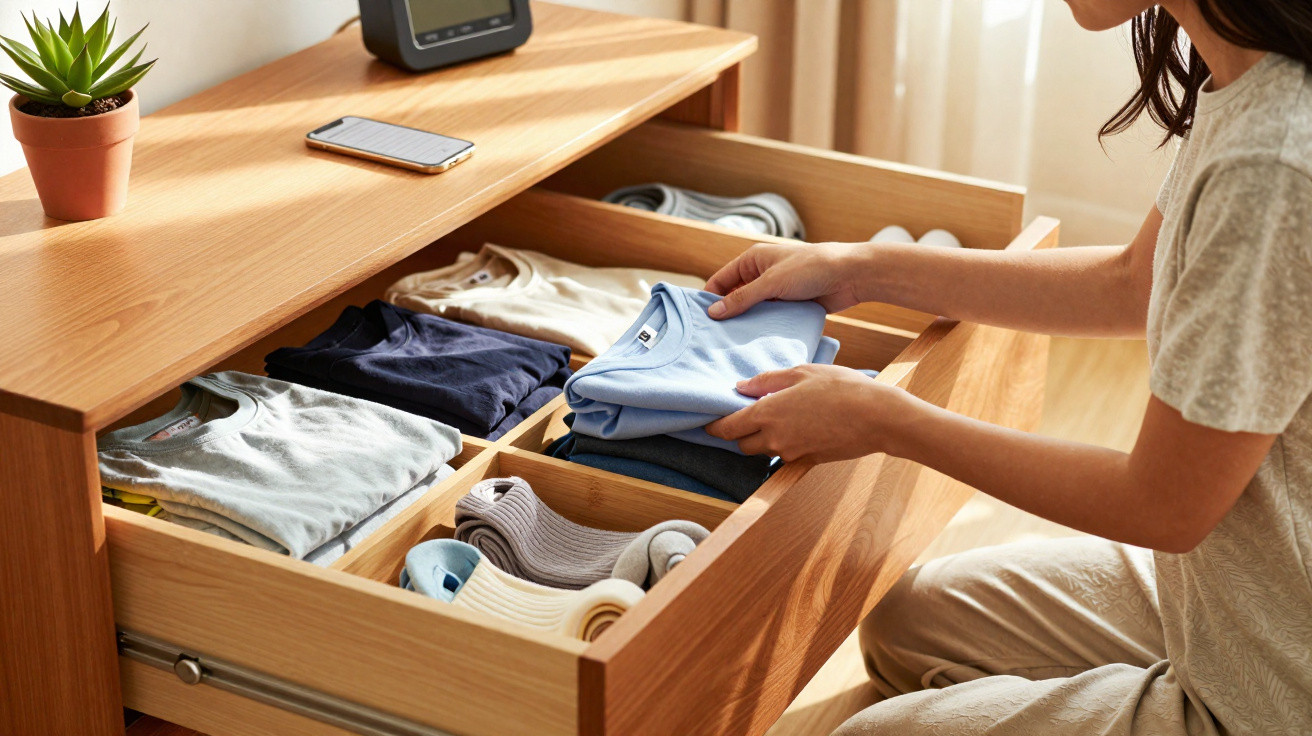
Begin with a single drawer rather than attempting them all. Empty its contents onto a table. Do not organise anything yet. Instead, separate the things you use daily or every few days. These are your A-list items. In the kitchen, they might include a coffee scoop, everyday cutlery and the sharp knife you always choose. In the bedroom, they could be underwear, regular socks and the T-shirts you wear repeatedly. Keep these A-list items in the front and middle of the drawer: the area your hand reaches first with no effort. This is your prime space.
Then deal with the B-list: items used every week or month. Place them behind the A zone or along its sides. Seasonal objects or things kept “just in case” should go right at the back, or preferably in a different drawer. A common error is to use a drawer as a storage box rather than as a runway for everyday routines. We fill it with old phone chargers, odd socks and unidentified keys, telling ourselves, “I’ll deal with this later.” Honestly, nobody does this every single day. We then accuse ourselves of being disorganised, even though the layout has opposed us from the beginning.
One Los Angeles organizer told me, “If you put your most-used item behind something else, you’ve basically scheduled future chaos. You’re forcing yourself to drag the mess forward every time you need that thing.”
- Keep everyday items in the drawer’s front-centre area.
- Put items you usually take together beside one another rather than spreading them around.
- Use shallow trays or boxes to prevent small items from drifting.
- Save the rear of the drawer for rarely used or seasonal belongings.
- Try the arrangement for a week, then alter anything that still feels inconvenient.
When your drawer layout fits your real life
There is a subtle sense of relief on the first morning you open a drawer and every item is exactly where your hand anticipates it will be. No rattling and no small-scale search, just a single easy movement. It does not resemble a social-media makeover. Instead, it feels rather like finally breathing out. You may also realise that you are no longer slamming the drawer shut. You do not leave it partly open because searching through it was frustrating. You close it automatically because opening it is no longer troublesome.
The surprising part is how individual this is. Your A-list could contain a garlic press and chopsticks, while somebody else’s may include a peeler and wine opener. In your sock drawer, running socks might deserve the best position if you jog every morning, or thick wool socks might take it if you work in a cold home office. The “right” placement is the one that matches your actual life, not the catalog version of it. Once that connection works, your drawers begin to cooperate. They will not stay perfect for ever, but they will remain manageable long enough for tidying to be a brief reset rather than a complete excavation.
You may even find yourself reconsidering which items deserve a place there at all. That third spatula you never touch starts to seem like an unwelcome guest. The broken pen at the back of the desk drawer suddenly lacks any justification. A well-placed drawer doesn’t just stay organized; it quietly changes what you keep. It encourages you to keep less, choose easier options and retain what you truly use with your own hands every day. Repeated through a kitchen, bedroom and bathroom, that small adjustment can transform the entire feel of your mornings.
| Key point | Detail | Value for the reader |
|---|---|---|
| Prioritise by frequency | Reserve front-and-centre space exclusively for everyday items | Drawers remain organised with less effort |
| Use simple zones | A-list at the front, B-list at the sides/back, rare items right at the rear | Quicker access and less rummaging |
| Edit as you go | Remove items that have not earned their place | Less visual clutter and mental overload |
FAQ:
- Question 1 How often should I reorganise my drawers after arranging them by frequency?
- Question 2 What if my drawer is extremely small and everything seems to be at the “front”?
- Question 3 Do I genuinely need organisers and trays, or can this method work without them?
- Question 4 How should I manage shared drawers when other people do not follow the system?
- Question 5 Which drawer would you suggest tackling first if I feel overwhelmed?



Comments
No comments yet. Be the first to comment!
Leave a Comment