
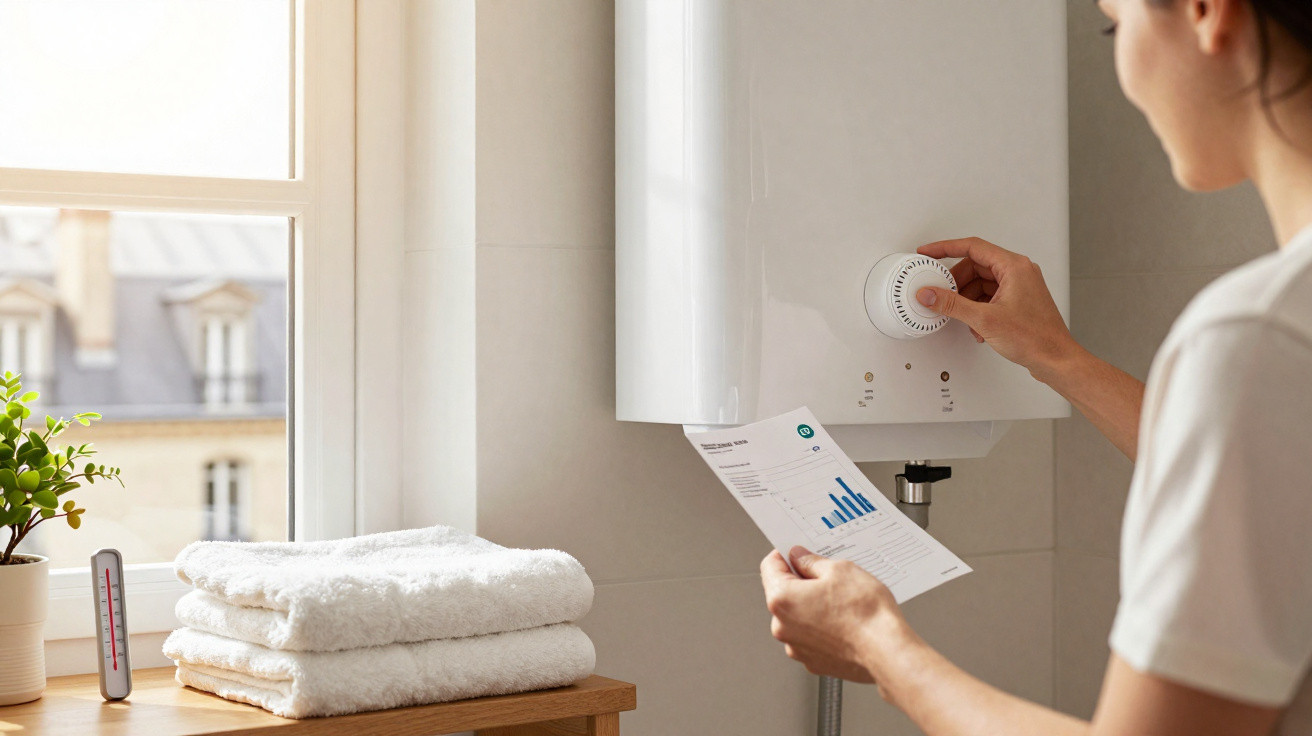
As winter approaches in France, one straightforward adjustment to a water heater can cut electricity use without compromising comfort.
As the first chilly mornings arrive, many households start thinking again about the energy used to heat water. An electric water heater is among the most power-hungry appliances in a home, yet an often-overlooked setting may help reduce bills. According to an article published by an online outlet specialising in energy consumption, the solution lies on the appliance itself, long before cutting the time spent in the shower.
Why a water heater adds so much to the bill
In homes fitted with a hot-water cylinder, the electric water heater accounts for a substantial share of annual energy consumption. It heats tens, and sometimes hundreds, of litres of water to a high temperature, then continually maintains that heat.
Every unnecessary degree comes at a cost. Throughout both day and night, the unit has to make up for heat losses. Consequently, the electricity meter continues running even when nobody turns on a tap.
The experts quoted by the news website point out that domestic hot water, alongside space heating, is one of the two main sources of household energy spending. Adjusting the cylinder setting can therefore have a noticeable effect on bills, without changing everyday habits such as how often people shower.
“The most effective setting is to adjust the hot-water cylinder temperature: high enough for health safety, but no higher in order to avoid waste.”
The key water-heater setting: adjust the cylinder temperature
Most electric water heaters are fitted with a thermostat, frequently concealed behind a cover or access panel. On many units, the factory setting is very high, sometimes around 70 °C, which is well above a household’s actual requirements.
The principle highlighted in the article is straightforward: lowering this setting to a more sensible level reduces the energy needed to heat the water while delivering the same shower comfort. In practice, users do not notice a difference because water from the cylinder is already mixed with cold water at the mixer tap.
The lower health limit that must never be crossed
However, this setting must not be changed at random. French public-health authorities state that a cylinder must be set to at least 50 °C at the outlet point to prevent the growth of legionella, the bacteria that cause Legionnaires’ disease. Professionals generally advise aiming for around 55 to 60 °C at the cylinder, leaving a safety margin.
The article stresses that this advice is based on those recommendations and must not be taken as encouragement to go below health thresholds. A setting of roughly 55–60 °C reduces consumption compared with a cylinder set to 65 or 70 °C, while maintaining safety.
“Lowering the set temperature by a few degrees, without dropping below the recommended limits, is already enough to reduce a water heater’s electricity costs.”
A direct effect on electricity consumption
A water heater’s energy use is determined in particular by three factors: cylinder capacity, the set temperature and heat loss. By reducing the set point, the appliance needs to operate less often to compensate for those losses.
Many energy specialists explain that a modest temperature reduction can generate meaningful savings over a year. The outlet notes that, without altering shower duration or the number of baths taken, the amount of energy needed to bring water to the required temperature falls automatically.
There is another benefit: a cooler cylinder can also reduce wear on certain components, including the heating element, which is often heavily affected by limescale where water is both very hot and hard.
How to check and adjust your water-heater setting
To make use of this option, the thermostat must first be accessed. On newer models, the temperature can be read from a simple graduated dial or even a digital display. On others, the control only has “+” and “–” markers, with no precise temperature shown. In that case, checking the tap water with a kitchen or DIY thermometer can help estimate the new setting.
- Switch off the electricity supply before carrying out any work on the appliance.
- Open the lower or side cover to reach the thermostat.
- Identify the current setting and lower it slightly, without going below the recommended range.
- Replace the cover, turn the power back on and wait for a full heating cycle.
- Check the hot-water temperature at the tap with a thermometer.
The website advises that, if there is any uncertainty or the appliance is old, calling an electrician or heating and plumbing engineer remains the safest choice. A professional can also inspect the cylinder’s overall condition and check for limescale.
Off-peak hours and maintenance: further useful measures
The article emphasises that this adjustment forms part of a wider set of good practices. Where an electricity tariff allows it, the water heater should ideally run during off-peak hours. A simple day/night contactor can restrict heating to the lowest-priced tariff periods.
Regular maintenance, including periodic descaling, also improves the cylinder’s efficiency. A heating element coated in limescale requires more energy to heat the water. Finally, choosing a cylinder appropriately sized for the number of people in the household avoids needlessly heating hundreds of litres that will not be used.
“The right temperature setting becomes particularly cost-effective when combined with off-peak operation and proper cylinder maintenance.”
What this means in practice for a household in France
In France, guidance from health authorities and plumbing professionals is consistent: the cylinder temperature should not be lowered below roughly 55–60 °C. The adjustment suggested by the specialist outlet is therefore mainly aimed at households whose water heater is set far above this range, sometimes having remained at the installation default.
For a household that has kept a very high setting through habit or concern about running out of hot water, simply returning to the recommended range reduces consumption and heat loss while retaining the same comfort in the shower. The user continues to operate the mixer tap in the same way, as the water is still blended with cold water.
Energy suppliers and the French Agency for Ecological Transition have for several years highlighted domestic hot water as an accessible source of savings that does not require major investment. Adjusting the cylinder temperature is among the first actions recommended, even before replacing equipment.
| Cylinder setting | Effect on comfort | Effect on consumption |
|---|---|---|
| Very high (around 70 °C) | Very hot water, requiring extensive mixing with cold water | High electricity consumption, greater heat losses and rapid limescale build-up |
| Intermediate (around 60 °C) | Usual shower comfort, with temperature easily adjusted at the mixer tap | Lower consumption and health safety maintained |
| Too low (below 50 °C) | Lukewarm water at peak demand | Risk of bacterial growth; not recommended |
A simple adjustment, but one requiring care
Lastly, the outlet notes that every home has its own characteristics: the age of the cylinder, water quality, how well the tank is insulated, and whether or not a thermostatic mixer valve is fitted. The adjustment should therefore be made gradually and accompanied by checks.
For readers in France, this advice has immediate appeal: it requires neither building work nor new equipment, only a few minutes to inspect the water heater. At a time of high electricity prices, this adjustment can help, alongside other measures, to keep bills down without giving up the expected comfort of a shower.
It can also be combined with simple daily habits: avoid leaving water running unnecessarily, choose a shower rather than a bath where possible, and insulate hot-water pipes for several metres from the cylinder outlet to reduce heat losses between the tank and the bathroom.

Comments
No comments yet. Be the first to comment!
Leave a Comment