
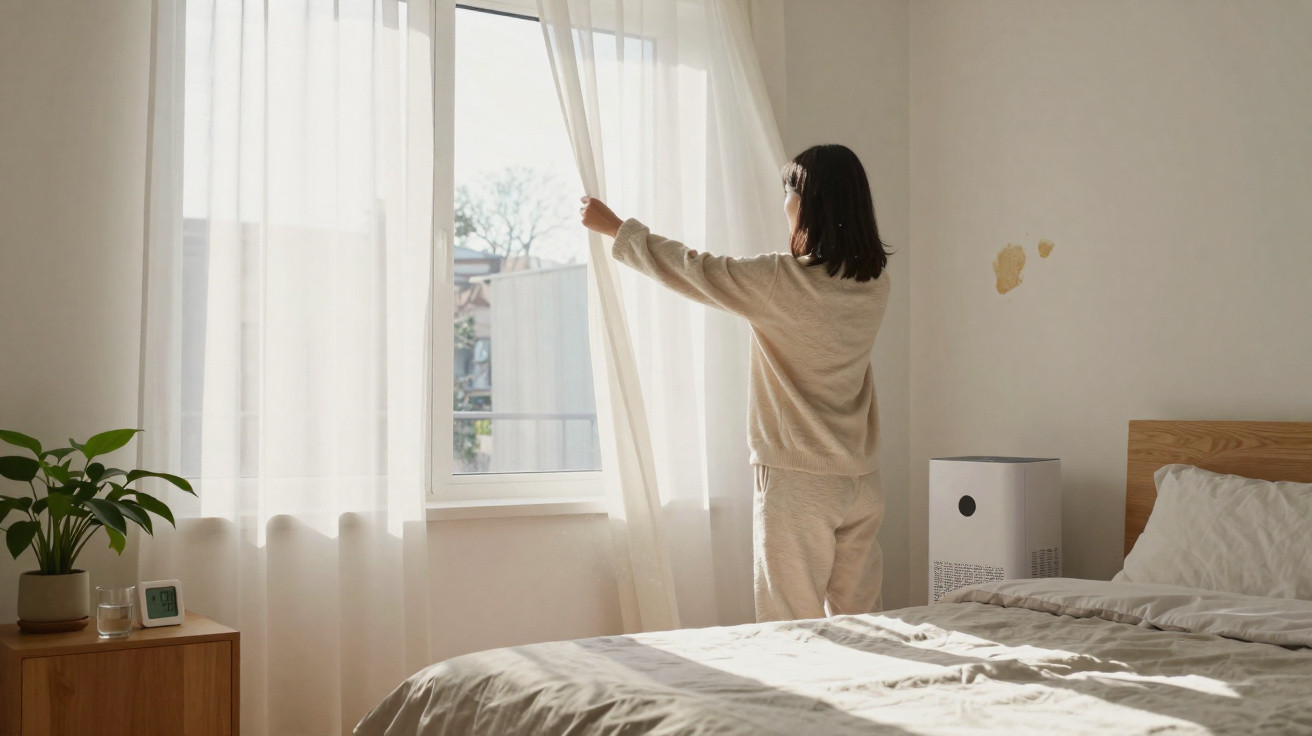
One January morning, you pull back the curtain and spot a small grey shadow in the corner of the wall, just behind the headboard. The window is still streaming with condensation, the bedding feels cold, and a slightly heavy smell hangs in the bedroom: we all know that moment of wondering whether the problem was already there the day before. In winter, bedrooms quietly trap moisture produced by breathing, showers, drying laundry or poorly insulated walls. The good news is that a ten-minute habit, repeated every day, can genuinely transform the air in the room.
Why bedrooms are ideal breeding grounds for mould in winter
A bedroom can seem perfectly healthy because it is tidy, peaceful and rarely looks visibly damp. Yet over the course of one night, two people can release several hundred millilitres of water into the air simply through breathing and perspiration, especially when the heating is on and the door remains closed. This moisture eventually settles on cold surfaces: a windowpane, an external wall or the concealed space behind a wardrobe. That is where the first black marks appear, quietly and almost unnoticed.
In an older flat, Claire had got into the routine of wiping condensation from her daughter’s bedroom windows every morning. She believed the issue was solely caused by ageing double glazing, until a damp patch appeared behind furniture pushed against the wall. The thermometer read 19 °C, but humidity was above 70%, whereas a bedroom generally feels more comfortable at around 40 to 60%. A straightforward reading from a small hygrometer helped her understand what the windows had already been telling her.
Mould does not appear simply because a home is necessarily poorly maintained. What it particularly thrives on is the combination of moisture-laden air, a cool surface and insufficient air movement. In winter, it is entirely understandable to keep everything shut to retain warmth, but this traps the water vapour indoors. A cold wall does not need to be wet to become vulnerable. Just a few days of regular condensation may be enough to create conditions that suit spores, particularly in corners and behind furniture.
The ten-minute habit that really freshens bedroom air
The most effective habit is to open the bedroom window fully for ten minutes every morning, ideally as soon as you get up. Better still, create a through-draught by opening a window in another room as well, with the bedroom door open. This brisk burst of ventilation removes humid air without cooling the walls and furniture for long, unlike leaving a window slightly open for hours. Ten minutes of fresh air is often more effective than half a day of hesitant ventilation.
Many people are reluctant to open windows when it is very cold outside, worried about increasing their heating bill or turning the room into an icebox. Let us be honest: hardly anyone manages it every day, especially on rushed mornings or while children are still asleep. However, cold outdoor air usually contains less absolute moisture than saturated indoor air; once warmed, it becomes drier. The sensible compromise is straightforward: turn down or switch off the heating for those ten minutes, then close the window and restore the usual temperature.
This small routine works even better alongside a few quick checks, without making the morning feel like a household chore. A bedroom does not need to be immaculate to stay healthy, but air must be able to move and hidden areas need room to breathe.
“When windows are misted up on waking, it is not merely an aesthetic detail: it is often the first sign of excess humidity in the room.”
- Keep the bed and furniture 5 to 10 centimetres away from cold walls.
- Do not dry washing in the bedroom, even “just for one night”.
- Check that air vents are neither blocked nor covered.
- Wipe away visible condensation before it settles around seals.
Small details that stop bedroom humidity returning every week
Daily ventilation cannot solve everything if the bedroom contains several moisture traps. A mattress placed directly on the floor, for instance, cannot breathe properly and may hold moisture beneath it; a slatted bed base allows air to circulate far more easily. The same principle applies to very heavy curtains covering a radiator or bulky furniture pressed against an external wall. These are not serious mistakes, merely habits that encourage cold, stagnant areas.
Heating also needs a little balance. A freezing bedroom attracts condensation, while an overheated room often leads people to keep the windows closed, quickly making the air feel stuffy. A temperature of around 17 to 19 °C suits many households, provided humidity remains under control. An inexpensive hygrometer may prove more useful than a miracle product: it provides a figure, highlights unusual days and prevents you from relying on smell or the appearance of a wall alone.
If stains return despite airing the room, the situation needs closer attention. A slow leak, water ingress around a window, faulty mechanical extract ventilation or a thermal bridge may be responsible, and scrubbing the wall will not provide a lasting solution. Photographing how the marks develop, recording humidity levels and checking extraction vents can help establish a clearer diagnosis, particularly in a rented property. The aim is not to live with your eyes fixed on the walls, but to prevent the issue from becoming an endless battle.
| Key point | Detail | Benefit for the reader |
|---|---|---|
| Air the room every morning | Open the window fully for 10 minutes, creating a through-draught where possible | Quickly removes humid air built up overnight |
| Watch for condensation | Misted windows, a lingering smell, a cold wall corner | Allows action before black stains emerge |
| Let air circulate | Move furniture and the bed away from walls, keep vents clear | Reduces cold areas where mould takes hold |
The real change does not depend on a major spring clean or an expensive appliance sitting in a corner. It often begins in the morning: opening the window before making the bed, letting cold air in for a few minutes and watching the mist gradually disappear. The gesture is very ordinary, almost mundane, yet it also protects sleep, textiles, walls and sometimes the breathing comfort of those who are more sensitive. Every home tells a different story: some will need only this routine, while others may reveal an insulation or ventilation fault. Watching the air in your bedroom for a week and noting what changes after those ten minutes may already reveal answers that had gone unnoticed.






Comments
No comments yet. Be the first to comment!
Leave a Comment