
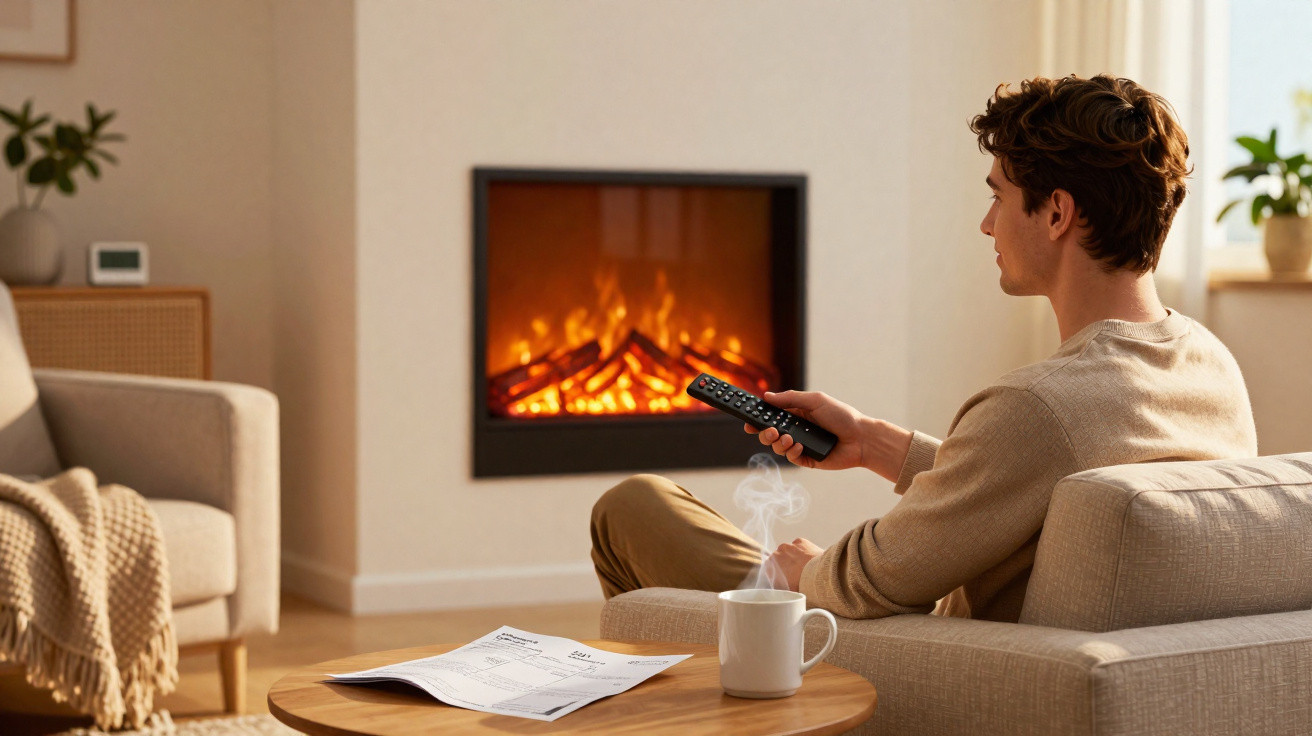
I mounted Lidl’s SEK 1800 A1 electric fireplace on the wall for an entire week. I had expected a seasonal novelty, but it proved to be a neat source of extra warmth, with a soft flame effect that became part of everyday life sooner than anticipated.
Design and living room fit
Its black glass frontage is discreet rather than imposing. It works particularly well alongside light timber, woollen throws and matt ceramics, giving a composed look instead of a showy one.
Measuring 90 x 55 x 13 cm, it fits comfortably above a sideboard or behind a sofa. Its shallow casing helps a smaller room retain an open feel, with no large floor-standing unit or tangle of cables underfoot.
The flame display is understated and can be adjusted. With five brightness settings, it can suit reading, television in the background or a quiet meal. It lights the wall without demanding attention.
“The faux fire doesn’t chase realism. It creates a mood that makes you forget the box doing the work.”
Setup and controls
Fitting it to the wall is a straightforward DIY task: two secure fixings, a spirit level and around thirty minutes if you work carefully. The touch controls remain concealed when not in use. The remote comes supplied with a battery, a minor detail that makes getting started easier.
Everyday settings that matter
The heater operates between 7–35 °C. Three modes make adjustments quick: Comfort supplies immediate heat, Eco aims for steadier energy consumption, and Anti-frost provides safe standby protection while you are away. A daily timer lets you programme switching times.
Two practical safety functions are useful in normal use. Open-window detection stops the heater when its sensor detects a draught. A key lock prevents unintended button presses when children are visiting. The display is easy to understand at a glance.
“Crack a window and the heat pauses. That wasted kilowatt-hour stays off your bill.”
Lidl SEK 1800 A1 heat and power use: benefits and compromises
With one 1,800 W heat setting, the SEK 1800 A1 can raise the temperature in a medium-sized living room during mild winter periods or on colder evenings. It is not intended to heat an entire home, but it can remove the chill and reduce how often the boiler needs to cycle.
It also remains quiet in use, without an obtrusive fan noise interrupting conversation. The display darkens at night, so it does not distract from a film.
Its value proposition is straightforward. Priced at €139, it costs less than many competing models at roughly €250–€400, while retaining key functions including a thermostat, timer and safety locks.
| Spec | Detail |
|---|---|
| Model | Lidl SEK 1800 A1, wall-mounted |
| Size | 90 x 55 x 13 cm |
| Heat output | 1,800 W (single stage) |
| Thermostat range | 7–35 °C |
| Flame options | 5 light intensities |
| Controls | Touch panel + remote |
| Safety | Open-window cut-off, key lock |
| Scheduler | Daily on/off timer |
| Noise | Low in normal use |
| Mounting | Wall kit included |
| Price | €139 |
What impressed me, what raised questions
Strong points
- An atmospheric flame effect that remains tasteful and can be customised.
- Straightforward modes, an uncomplicated remote and quick daily operation.
- Works effectively as a local heater in the morning and evening.
- Useful anti-waste functions, with draught detection and the timer helping to reduce consumption.
- The price changes expectations for a safe, programmable unit.
Limits to keep in mind
- There is only one heat setting, so fine adjustments depend on the thermostat.
- The manual could give clearer guidance on advanced timer settings; some experimentation was necessary.
- It heats the area directly in front of it rather than a whole flat.
- Its clean, contemporary styling may not suit rustic or period décor.
- Promotional retail stock can disappear quickly, so plan ahead if you want one.
“€139 for a quiet, programmable backup heater with real safeguards feels like the right product at the right moment.”
How much does an hour cost?
At maximum power, it uses 1.8 kWh. At an electricity price of €0.25/kWh, one hour costs about €0.45. A relaxed two-hour evening session comes to roughly €0.90.
Once the target temperature has been reached, Eco mode reduces peaks and cycles less frequently. The timer avoids needless heating after bedtime or while you are on the school run. When used thoughtfully, it behaves more like a scalpel than a sledgehammer.
As an example, running it for 2 hours on each weekday and 3 hours a day at weekends totals about 66 hours in a month. At 1.8 kWh and €0.25/kWh, that works out at close to €30. In a well-sealed room, using Eco mode and a sensible setpoint, I recorded nearer €15–€20. Insulation levels and usage habits will alter the result.
Who should consider it this winter?
Winning scenarios
- A well-insulated flat with a medium-sized lounge used in the evenings.
- A cold extension or north-facing room outside the main heating circuit.
- A home office, where heating the person is preferable to heating the entire property.
- A second home, where Anti-frost mode offers reassurance.
When to look elsewhere
- Very large open-plan rooms requiring greater airflow and heat output.
- Primary heating for the full day, as this is an additional heating appliance.
- Period interiors that call for imitation cast-iron or timber surrounds.
Tips to get the best from it
- Position it at seated eye level to make the flame effect appear more natural.
- Use foam sealing strips on draughty windows so the draught sensor activates less often.
- Set it to start 15 minutes before getting up and 30 minutes before a film.
- If your electricity supply is unreliable, use a surge-protected extension lead.
- Leave 1 metre of unobstructed space in front of it, and keep heavy curtains away from the vents.
Why this price point matters
At €139, households receive a neat wall-mounted unit that can warm an occupied space without straining the budget. There are no apps, account sign-ins or confusing menu systems. Instead, it addresses a specific issue: a cold spot where people actually spend time. That is why interest extends beyond dedicated bargain hunters.
It will not replace an efficient central heating system. However, it can ease the chill in milder winter periods, cut down boiler cycling in the lounge and make the space feel inviting again. Its combination of perceived comfort, believable safety features and controllable running costs makes a stronger argument than the specification list alone.
Extra notes that help you decide
To work out your actual cost, record daily running time for a week. Multiply the hours by 1.8 kWh, then by your taxed price per kWh. Compare that figure with the cost of lowering the central heating thermostat during those same periods. In many properties, targeted heat is more effective when only one room is occupied.
Still deciding on the format? Wall-mounted models preserve floor space and help keep cables organised. Freestanding heaters can be moved between rooms, but may topple if knocked. Whichever type you choose, clean the air-intake grilles each month, check the child lock when visitors arrive and do not daisy-chain extension leads. If your energy tariff includes off-peak pricing, warm the room slightly before the more expensive period begins, then allow Eco mode to maintain the temperature.
Comments
No comments yet. Be the first to comment!
Leave a Comment