
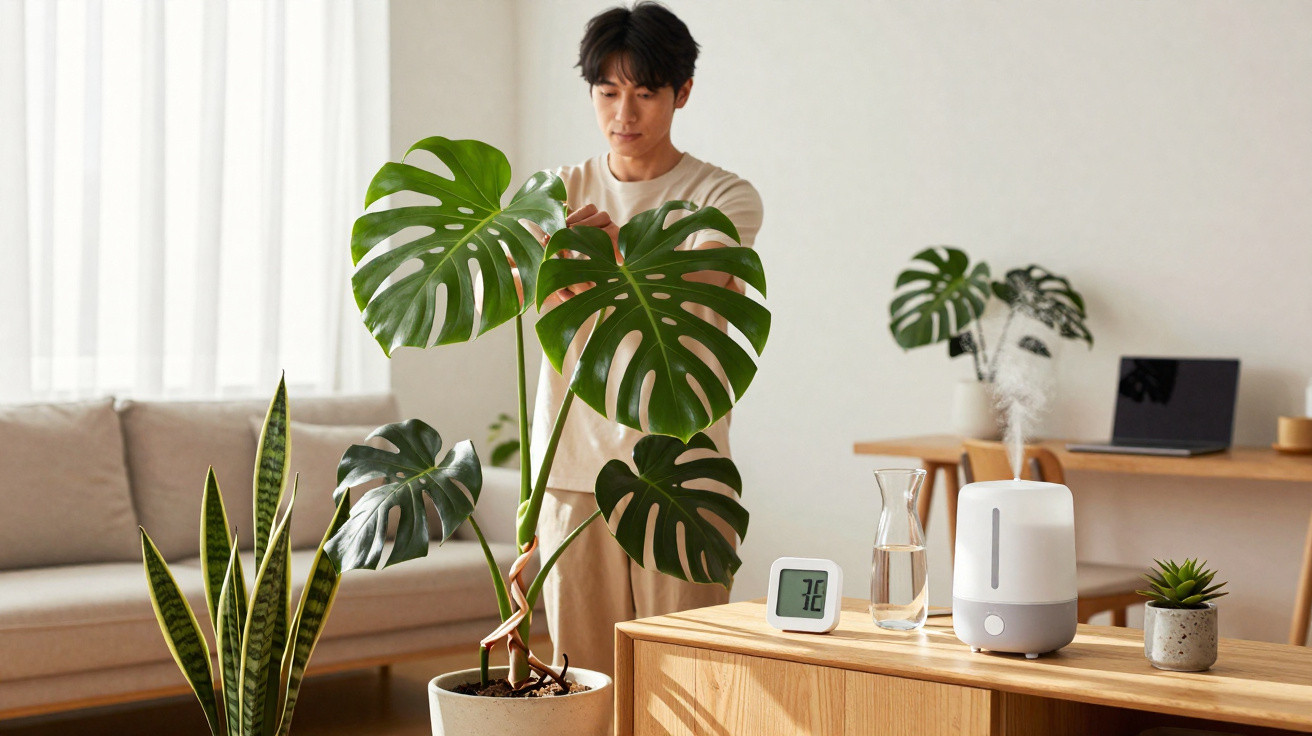
In countless living rooms, it has long taken centre stage: Monstera deliciosa, commonly known as the Swiss cheese plant or simply monstera. Social media celebrates it both as a design statement and an air-quality marvel. Yet does this fashionable houseplant genuinely improve indoor air in a noticeable way, or is its impact mostly symbolic?
What Monstera really does for indoor air
The basis of any effect on the air is straightforward: photosynthesis. A Monstera absorbs carbon dioxide and releases oxygen. Its large, perforated leaves provide a generous surface area for this process. It therefore makes a clear contribution to a more pleasant indoor climate.
“Monstera improves the living environment – but it does not replace mechanical air purification.”
Its broad leaves also act rather like dust collectors. Fine airborne particles settle on their surfaces instead of continuing to circulate around the room. Wiping the leaves regularly therefore removes some of the surrounding dust as well.
Can Monstera filter pollutants from the air?
The well-known NASA study from the late 1980s made houseplants as air purifiers an enduring topic. At the time, researchers tested a range of species in sealed spaces with high levels of pollutants. Monstera was not among the plants originally examined, although more recent research has included it.
The findings are clear: the Swiss cheese plant can absorb certain volatile organic compounds (VOCs) to a limited extent. However, the impact remains modest, especially in an ordinary living room where fresh air constantly enters, doors are opened and pollutant levels are far lower than in laboratory conditions.
| Pollutant | Effectiveness of Monstera | Note |
|---|---|---|
| Carbon dioxide | Moderate absorption | Only in light, through photosynthesis |
| Formaldehyde | Low reduction | A visible effect occurs only with several large plants |
| Dust particles | Relatively good capture | Broad leaves collect particles effectively |
| Benzene | Very low effect | Other species purify this far more effectively |
One plant in a 20-square-metre room will not create “laboratory air”. It is better viewed as a small, continuously operating addition to a wider approach involving ventilation, cleaning and mechanical filtration.
Comparing Monstera with established air-purifying plants
People who choose houseplants primarily for air purification often turn to familiar options such as snake plant, devil’s ivy or spider plant. Studies consider these species particularly hardy and efficient at processing certain pollutants.
- Snake plant (Sansevieria): Very easy to care for, filters various VOCs and tolerates dry air.
- Devil’s ivy: Vigorous-growing, with good results for pollutant breakdown in laboratory trials.
- Spider plant: Known for consistent air-purifying performance and uncomplicated care.
Monstera is more of a supporting player than a top performer in this group. Its real appeal lies elsewhere: it combines oxygen production, slight humidification through evaporation and enormous decorative impact.
More humidity, greater comfort
Through its leaves, a Monstera steadily releases water into the surrounding air. In homes affected by dry central-heating air, this can noticeably improve breathing comfort, reduce a scratchy throat and ease dry skin.
“Monstera plants act like small natural humidifiers – especially in groups.”
This increased humidity may indirectly help to protect mucous membranes and lessen irritation. Anyone who talks extensively while working from home or spends long periods at a computer may notice these differences sooner than abstract measurements for individual pollutants.
How many plants does a room really need?
Experts assume that around two larger plants per roughly ten square metres are needed to achieve measurable effects on air quality. With Monsteras, this is not particularly unrealistic, as they can eventually grow to an impressive size.
Anyone wanting to improve their living room deliberately could, for instance, combine:
- 1–2 large Monstera plants for humidity, oxygen and visual appeal
- 2–3 demonstrably “strong” air-purifying plants, such as spider plants or snake plants
- Regular burst ventilation and, where necessary, an air purifier with a HEPA filter
This creates a kind of plant team, with each plant taking on different functions. The Monstera becomes the visual focal point, while less conspicuous species quietly contribute in the background.
A healthy Monstera means better air: care makes the difference
Only a thriving plant can photosynthesise properly and add moisture to the air. To get the most from a Monstera, follow several simple principles:
- Water only when the top one to two centimetres of compost feel dry.
- Choose a bright position with indirect light, and avoid direct sunshine.
- Keep humidity at approximately 60 to 80 percent, for example using bowls of water or a humidifier.
- Wipe leaves regularly with a damp cloth so that dust does not “block” them.
- Repot into fresh compost every two years to support suitable roots and nutrient supply.
Neglecting these points may still leave you with a decorative plant, but one with a substantially reduced effect on the air. Yellow leaves, limp shoots and standing moisture in the pot are unmistakable warning signs.
Where a Monstera is most useful
Its position determines whether a Monstera is simply decoration or can genuinely contribute to the room climate. The best locations are areas where people spend a great deal of time, such as the living room, home office or reading corner.
It can also be kept in a bedroom, although opinions often differ on this. Some value the extra humidity there, while others dislike having large plants close to their sleeping area. If in doubt, place it by the window opposite the bed or slightly to one side.
Plants, wellbeing and productivity
One frequently overlooked benefit of Monstera has nothing to do with measurements: its psychological effect. Research indicates that even a few green plants in a room can reduce stress, improve concentration and lift mood.
“Many people feel more present, calmer and more creative with plants – entirely without a measuring device.”
Monstera is especially well suited to this because it is quickly seen as a “housemate”: large, striking and slightly wild in its growth. That character makes it particularly appealing for home offices, open-plan kitchen-living spaces and studios.
How to combine Monstera intelligently with other plants
Those taking air quality and wellbeing seriously are best served by mixed plant arrangements. One possible set-up for a 20-square-metre living room could include:
- One large Monstera near the window as a visual anchor
- A snake plant in the bedroom area or a shadier corner
- A spider plant on a shelf or hanging system to “work on” higher layers of air
- Smaller herbs or hardy green plants on the desk, close to the workspace
This spreads the effect across the entire room rather than concentrating it in one corner. At the same time, it creates small green zones that make the space feel more homely.
Risks and limitations: when plants are not the answer
Anyone with severe allergies, asthma or mould problems at home should not regard Monsteras and other houseplants as substitutes for structural or medical measures. In such situations, professional remediation, filtration systems and medical support matter far more than any “miracle plant”.
There is another consideration: excessive humidity caused by too many plants in small rooms can eventually encourage mould, producing the exact opposite of the intended outcome. A hygrometer helps keep humidity levels under control.
A realistic verdict, without myths
Monstera does clean the air, but only to a moderate degree. Anyone expecting a single pot to neutralise every pollutant will be disappointed. However, it works well as part of a sensible overall approach: regular ventilation, an air purifier if needed and a handful of carefully selected houseplants.
That is precisely where the Swiss cheese plant shines: as a large, distinctive plant that provides oxygen, releases moisture, captures dust and, as an added benefit, makes a home feel considerably more welcoming. For many people, that is enough to say: this plant improves my life – even if it cannot replace a medical device.



Comments
No comments yet. Be the first to comment!
Leave a Comment