
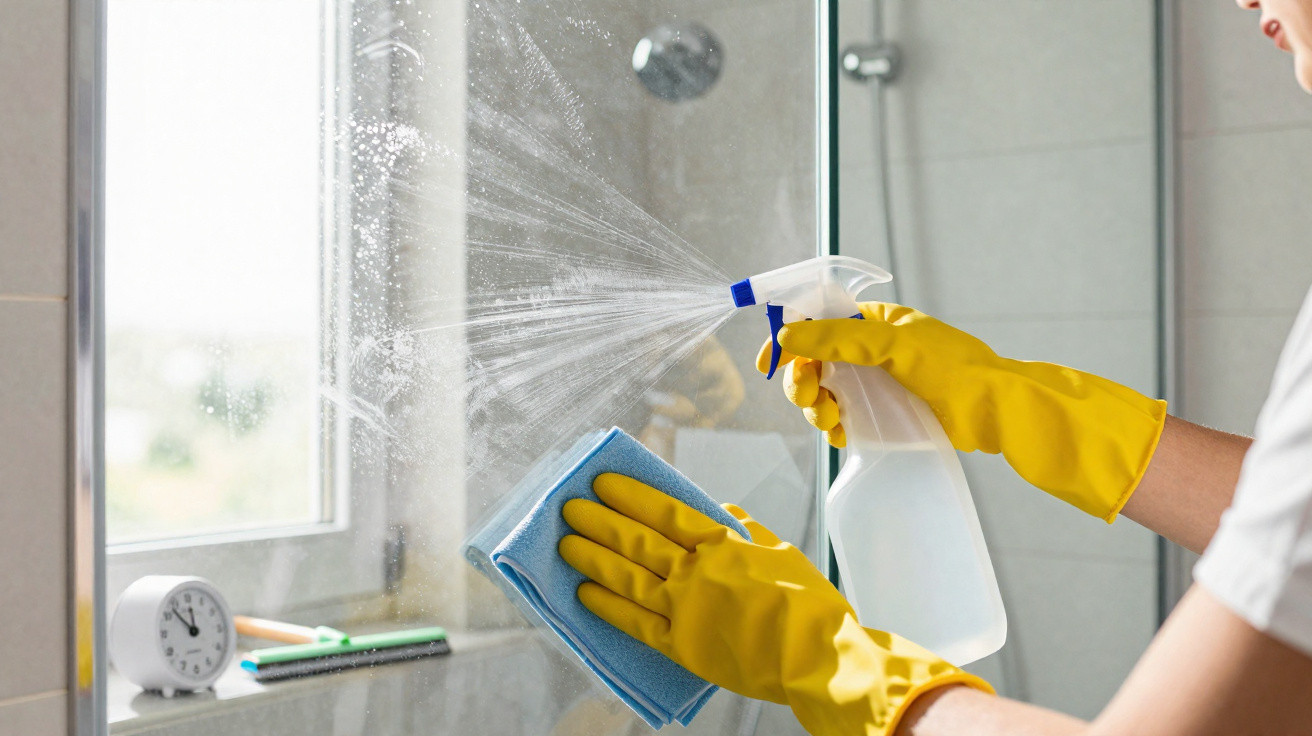
On a Saturday morning, sunlight falls at an angle across the shower screen and exposes what you would rather not notice: white marks, a dull film over the glass and seals that have yellowed in places. We all know the moment when we scrub with vinegar, then bicarbonate of soda, without really understanding why the result is still disappointing. The issue is not always a lack of elbow grease. More often, it is the wrong product being used on limescale that is already firmly established. Cleaning companies do not spend half an hour scouring every shower enclosure: they use a professional acidic descaler, often formulated with sulphamic acid. The process is straightforward, quick and far more targeted. The difference is visible almost immediately.
The professional product used when limescale is stubborn
In a shower with heavy limescale build-up, white vinegar has its limitations. Its acidity is relatively mild, so it may need a long contact time, repeated applications and more scrubbing. Professionals tend to choose a sulphamic-acid descaler, available as a gel or concentrated liquid, because it breaks down mineral deposits without requiring huge effort. On a glass shower screen, it clings better than a product that is too runny and does not immediately drain into the shower tray. That detail makes all the difference.
In hotels, holiday residences and properties being handed back after a rental, time is limited. An experienced cleaner will often say that, on an enclosure maintained regularly, five minutes of contact time is enough to lift the white film left by hard water. A study by the French Agency for Food, Environmental and Occupational Health & Safety notes that hard water is not dangerous to drink, although it can leave stubborn deposits on heated or constantly wet surfaces. A shower is therefore the ideal setting for this small daily battle.
Sulphamic acid works directly on calcium carbonate, the main component of limescale. When the deposit comes into contact with the acid, it gradually dissolves, avoiding the need to scratch glass or chrome with an abrasive sponge. The aim is not to scrub harder, but to let the right product do the work for you. The five-minute claim naturally applies to an ordinary layer of limescale, not a shower screen neglected for three years behind a shower curtain.
The five-minute express method without damaging the shower
First, give the screen a quick rinse with lukewarm water, then remove the larger droplets with a squeegee or cloth. Spray the professional descaler over the glass, taps and whitened areas, while avoiding delicate surfaces that the manufacturer advises against treating. Leave it to work for three to five minutes, never longer simply “to be safe”. Then wipe with a non-abrasive sponge or damp microfibre cloth and rinse thoroughly with clean water. The final, often overlooked step is to dry the surface.
Many people mistakenly assume that a harsher product must automatically work better. They then pour on a large amount of descaler, close the bathroom door and wait for fifteen or twenty minutes. Let us be honest: nobody really does that every day, and there is no need to. A properly applied gel, a controlled contact time and thorough rinsing deliver a cleaner result than piling up homemade remedies. Wear gloves, ventilate the room and keep the product away from children.
Materials require particular care: marble, natural stone, some delicate seals, unprotected aluminium and damaged surfaces do not all react to acids in the same way. Always test a small, inconspicuous area before treating the entire enclosure, particularly if your shower is a few years old or has matt finishes.
“A good descaler should dissolve limescale, not strip the entire bathroom,” is a simple rule often repeated by cleaning staff.
- Choose a descaler that states it contains sulphamic acid or phosphoric acid.
- Never mix an acidic product with bleach.
- Use a microfibre cloth or soft sponge, never steel wool.
- Rinse generously, especially around the mixer tap and seals.
- Finish with a squeegee to slow the return of white marks.
The real secret to spotless showers is not a miracle product
A gleaming shower does not depend solely on the bottle kept beneath the sink. It mainly depends on what happens immediately after showering, when water remains on the screen and dries naturally, leaving its minerals behind. Using a squeegee for twenty seconds may seem almost too simple to work. Yet it is this step that reduces the need for major descaling sessions and preserves the appearance of the glass. Light weekly maintenance prevents the dreaded big Sunday clean.
| Key point | Detail | Benefit for the reader |
|---|---|---|
| Professional descaler | Gel based on sulphamic or phosphoric acid | Works quickly on established limescale |
| Contact time | Three to five minutes, according to the instructions | Prevents excessive scrubbing and streaks |
| Daily maintenance | Squeegee and quick drying after showering | Limits the return of the white film |
There is also an element of realism in all this. If the water is very hard where you live, marks will always return to some extent, even in a new, perfectly ventilated bathroom. The point is not to fight every day for a flawless advertising-style shower, but to choose habits that make the chore less unpleasant. Between vinegar that struggles, bicarbonate of soda that does not truly dissolve limescale and a correctly dosed professional descaler, the difference often comes down to a few minutes. And seeing that transparent shower screen restored without exhausting yourself can sometimes make you want to tackle the rest of the bathroom.


Comments
No comments yet. Be the first to comment!
Leave a Comment